 0866 022 097
 institute@mescells.com
Dan Tri Newspaper – Bach Mai Hospital Studies the Use of Stem Cells in Treating Cirrhosis


(Dan Tri) – Advances in treatment are opening up more opportunities for patients with cirrhosis. Among them, stem cell therapy is a line of research attracting interest in Vietnam and worldwide.
Ministry of Health sets direction for standardizing clinical research
On 16 September, the Mescells|MSC Specialized Healthcare System for Regenerative Medicine & Cell Therapy and Bach Mai Hospital signed a cooperation agreement on research into the application of mesenchymal stem cells in clinical treatment.
Under the agreement, the two sides will work together on research programs and the development of cell products, and prepare the scientific and legal dossiers and other conditions needed to conduct clinical trials in accordance with regulations.
Biomedical products arising from the joint research may be further refined and developed in accordance with the law.
They will also research and apply solutions, technical procedures and professional models suited to the practical needs, implementation conditions and development direction of Bach Mai Hospital.
Cirrhosis and musculoskeletal diseases are chronic conditions in need of additional new treatment options. Recent studies around the world have shown the potential of stem cell therapy, so this cooperation is expected to promote research and the application of new techniques in practice.

Dr. Nguyen Ngo Quang, Director General of the Department of Science, Technology and Training, Ministry of Health (Photo: T.M).
Speaking at the event, Dr. Nguyen Ngo Quang, Director General of the Department of Science, Technology and Training at the Ministry of Health, said that cell technology is currently one of three strategic technologies that the Prime Minister has assigned the health sector to implement, with the aim of creating safe and effective products, methods and techniques for use in treating Vietnamese patients.
The Ministry of Health is directing units to implement this urgently, aiming for concrete results soon. Recently, the Ministry has issued guidance documents so that units, including Bach Mai Hospital, can draw up implementation plans in accordance with the law.
In addition, some non-public organizations are also investing systematically in technology transfer, research and cell production, especially mesenchymal cells from the umbilical cord.
“Bach Mai Hospital is a special-grade hospital with an important role in developing and mastering advanced techniques; if the hospital does not take the lead, it will be difficult to replicate the model,” Dr. Quang said.
He asked Bach Mai Hospital to standardize its system for managing research and clinical trials, particularly stem cell research. Alongside clinical expertise, clinical trials involving stem cells must be carried out methodically, with complete procedures and legal documentation.
In terms of research direction, the Ministry of Health encourages Bach Mai Hospital to cooperate in conducting clinical trials using umbilical cord-derived mesenchymal stem cells in a number of treatment areas: cirrhosis, especially compensated cirrhosis, and certain musculoskeletal diseases…
The Ministry of Health expects that by the end of this year or early next year there may be concrete initial results to report to the Ministry’s leadership and the Government.
Assoc. Prof. Dr. Nguyen Tuan Tung, Deputy Director of Bach Mai Hospital, said that alongside its duty as a last-line hospital for examination and treatment, the development of science and technology, training and scientific research form the “three-legged stool” that the hospital always pursues and develops together.
According to Assoc. Prof. Tung, proactively researching, producing and applying cell technology domestically can give patients easier access to new techniques at a reasonable cost. Dependence on imported technology, by contrast, can drive up costs and limit patient access.
The leadership of Bach Mai Hospital also stressed that it will review and strictly manage research and clinical trials.
A further option for treating cirrhosis
Speaking on the sidelines of the event, Assoc. Prof. Dr. Do Tuan Anh, former Head of the Department of Infectious Diseases at Military Hospital 103, Vietnam Military Medical University, said that cirrhosis can arise from many causes. In Vietnam, the most common is cirrhosis due to hepatitis B and C viruses, followed by alcohol and other forms of toxicity.
According to the expert, cirrhosis can be regarded as the severe, advanced stage of liver disease. The liver performs many important functions, so when it becomes fibrotic these functions all decline, bringing many serious manifestations.
Patients may suffer metabolic disorders, loss of appetite, indigestion, abdominal distension, diarrhea or vomiting. Impaired bile synthesis and secretion can cause jaundice of the skin and eyes and dark yellow urine.
Worryingly, blood clotting is also affected, making patients prone to bleeding; internal bleeding in particular can be life-threatening.
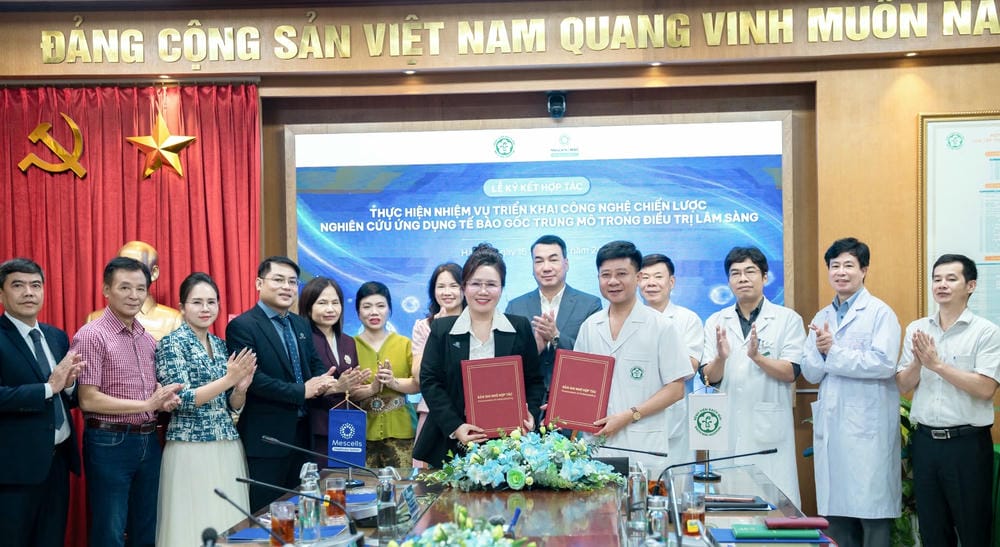
The signing ceremony opens up a new direction for the treatment of cirrhosis (Photo: T.M).
When cirrhosis progresses to the decompensated stage, the burden of disease on patients and their families is very heavy, and it also puts pressure on the health system.
Assoc. Prof. Dr. Do Tuan Anh said that recent medical advances have helped reduce the burden of disease and prolong patients’ survival. Stem cells are also being studied as a potential approach.
In Vietnam, the Ministry of Health has not yet officially licensed the use of mesenchymal stem cells to treat cirrhosis. Research results from many countries show that this method can help stabilize liver function for a certain period of time.
“However, it must be understood that stem cells do not restore liver function to what it originally was; keeping liver function at a stable level is already a very good outcome,” Assoc. Prof. Tuan Anh said.
Source: Dan Tri Newspaper






 Hotline
 Zalo
Zalo
 Fanpage