 0866 022 097
 institute@mescells.com
Mescells International-Standard Research Institute Facilities


Mescells Research Institute is one of the first private institutions in Vietnam to be licensed by the Ministry of Science and Technology to conduct research on cell technology for applications in regenerative medicine. In addition to its scientific research activities, Mescells Research Institute is also a pioneer in international collaboration, receiving technology transfers in advanced cell technologies from leading countries in the field, including Japan and the United States. With a modern laboratory facilities developed in accordance with WHO-GMP standards, Mescells Research Institute aims to conduct research, develop technologies, and bring the world’s most advanced achievements in cell technology to people in Vietnam.
GMP (Good Manufacturing Practices) is a system of regulations or guidelines designed to ensure that manufacturers consistently produce products that meet registered quality standards and are safe for users. According to the Ministry of Health, GMP standards are mandatory for all fields involving the production and processing of products requiring high standards of hygiene and safety, such as pharmaceuticals, food, cosmetics, and medical devices, including cell-based products used in the treatment of diseases. GMP helps ensure that products are manufactured consistently and controlled according to standards appropriate to their intended use and in compliance with applicable marketing authorization requirements, while minimizing risks that cannot be adequately controlled through testing, such as cross-contamination and mix-ups.
The laboratory operations at Mescells Research Institute strictly comply with the GMP guidelines issued by the World Health Organization (WHO), including WHO Good Manufacturing Practices for Biological Products, Annex 2, TRS No. 999 – 2016. These guidelines cover requirements for facilities, working environment controls, personnel, and the control of processes for the collection, processing, culture, storage and preservation, and distribution of cell products.
1. Facilities and Working environment
Mescells Research Institute has a laboratory facilities divided into areas with different cleanliness levels, including the Cell Culture and Production Room, Quality Control Room, Product Storage Room, and other supporting areas such as technical areas, biological sample receiving areas, and product dispatch areas.
The air throughout the laboratory is controlled by an AHU (Air Handling Unit) system using multiple levels of filtration, including pre-filters, secondary filters, and HEPA filters capable of removing ultrafine contaminants such as dust and bacteria measuring 0.3 microns. The rooms are designed with positive pressure at different pressure levels to prevent airflow from less clean areas into clean areas. The AHU system also provides temperature and humidity control, ensuring stable environmental conditions over time.
The Mescells Research Institute laboratory has received ISO 14644-1:2015 certification, meeting standards for the design, construction, and operation of cleanrooms.

2. Equipment
With the goal of developing an internationally standardized scientific research institute, Mescells Research Institute has invested in modern equipment manufactured by reputable global brands and certified to meet quality management standards. Notable equipment includes:
2.1. CelCulture® CO₂ Incubator by Esco

This incubator is widely used in cell-related laboratories. It has a ULPA filtration system and a validated high-temperature sterilization function certified by the UK’s Health Protection Agency, with precise temperature and airflow control.
2.2. Airstream® Class II Biological Safety Cabinet by Esco

The cabinet is used by technicians when performing procedures involving cells. It is a standard-size unit with three protective functions – protecting the biological sample, the user and the environment – and meets the European standard EN12469.
2.3. ECLIPSE Ts2 Inverted Microscope by Nikon

The microscope uses the CFI60 optical system, the most advanced in the world, providing clear images at every magnification. In addition, phase-contrast observation makes cell images sharper and more vivid.
2.4. FACSCanto™ II Flow Cytometry System by BD Biosciences

BD Biosciences has more than 35 years of experience and is a leading company in the development of cell analysis systems. The FACSCanto™ II system offers advanced functionality with ease of operation while providing accurate, high-quality analytical results.
2.5. QuantStudio 5 real-time PCR system by ABI
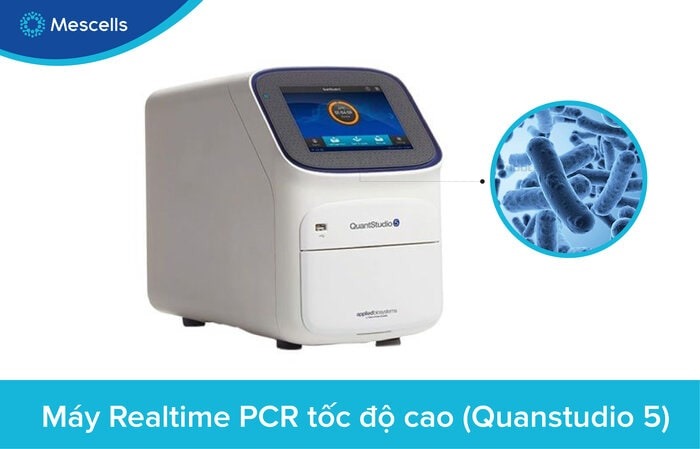
The system is used to detect and quantify target nucleic acid sequences based on PCR (polymerase chain reaction) and fluorescence signals. At Mescells Research Institute, the system is used to detect the presence of mycoplasma in cell products, study the expression of functional genes involved in cellular activity, and support other applications.
2.6. Lexicon® Ultra-low Temperature Freezer by Esco

The freezer is manufactured using high-quality, validated components and an energy-efficient cooling design, providing long-term protection for cell samples while maintaining their integrity. The product complies with ANSI/ASHRAE 72-2005 and ARI 1200-2006/2008 standards and has been verified by three different laboratories affiliated with Underwriters Laboratories (UL).
2.7. MVE XC 47/11-10 Liquid Nitrogen Storage Vessel by Chart

The vessel is used to maintain cell samples in a liquid nitrogen environment for long-term static storage. With a capacity of up to 1,050 cell sample tubes, it is manufactured from durable, lightweight materials and uses vacuum technology to retain liquid nitrogen for extended periods with minimal evaporation.
3. Quality system
In routine operations, quality control (QC) and quality assurance (QA) procedures are established to build a quality system that assures the collection, processing, storage and distribution of cell products for therapeutic applications.
Before cell products and their derivatives can be used in clinical research and treatment protocols, they must undergo rigorous quality control testing, including endotoxin testing, mycoplasma testing, sterility testing, chromosomal integrity assessment, and evaluation of cell characteristics. This process ensures the maximum efficacy and safety of biological products for human use.
Besides, the work of researchers and technicians is closely supervised to prevent microbial contamination and cross-contamination between different biological samples.
4. Personnel
Members of Mescells Research Institute have a solid grounding in cell technology, having trained in this specialty at reputable universities. Most hold postgraduate qualifications and therefore possess professional research and laboratory skills.
Before participating in production processes, all personnel are comprehensively tested and assessed against criteria of qualifications, health (free of infectious diseases) and discipline. Once officially employed, researchers and technicians at Mescells Research Institute receive additional skills training, undergo regular health check-ups, and participate in academic exchange sessions to continuously enhance their knowledge.
With facilities and operating policies built to GMP – WHO standards, Mescells Research Institute is committed to its capacity to conduct scientific research and apply advances in cell technology to practical medicine.

Head of the Department of Immunology, Vietnam Military Medical University






 Hotline
 Zalo
Zalo
 Fanpage