 0866 022 097
 institute@mescells.com
The Potential of Mesenchymal Stem Cells in Treating Osteoarthritis


Osteoarthritis is a chronic disease that causes pain, impairs mobility and seriously affects quality of life. It is especially common among older people, those who are overweight or obese, and those who have had joint injuries. In practice, many conventional medical treatments provide only temporary pain relief and cannot restore damaged cartilage or prevent the disease from progressing.
In response, treatment of osteoarthritis with mesenchymal stem cells (MSCs) has emerged, opening up a promising way to regenerate tissue and cartilage within the field of regenerative medicine. In this article, the team of experts at Mescells will help you better understand the real potential of this advanced therapy and how it works.
1. The big picture: osteoarthritis and the need for mesenchymal stem cell (MSC) treatment
Osteoarthritis is one of the leading causes of disability and reduced mobility worldwide. According to in-depth medical statistics, the disease is rising sharply along with population aging and obesity, and currently affects about 10% of men and 13% of women over the age of 60 – equivalent to more than 250 million people around the world enduring persistent pain every day.
The disease is characterized by the continuous degeneration of joint cartilage – the natural cushion that lets the ends of the bones glide smoothly over each other. Along with the destruction of cartilage, the bone beneath it remodels abnormally, and chronic inflammation of the synovial membrane leaves patients in constant pain, with stiff joints and difficulty in even the most basic daily activities.
>>> Learn more: The potential of stem cells in treating knee osteoarthritis
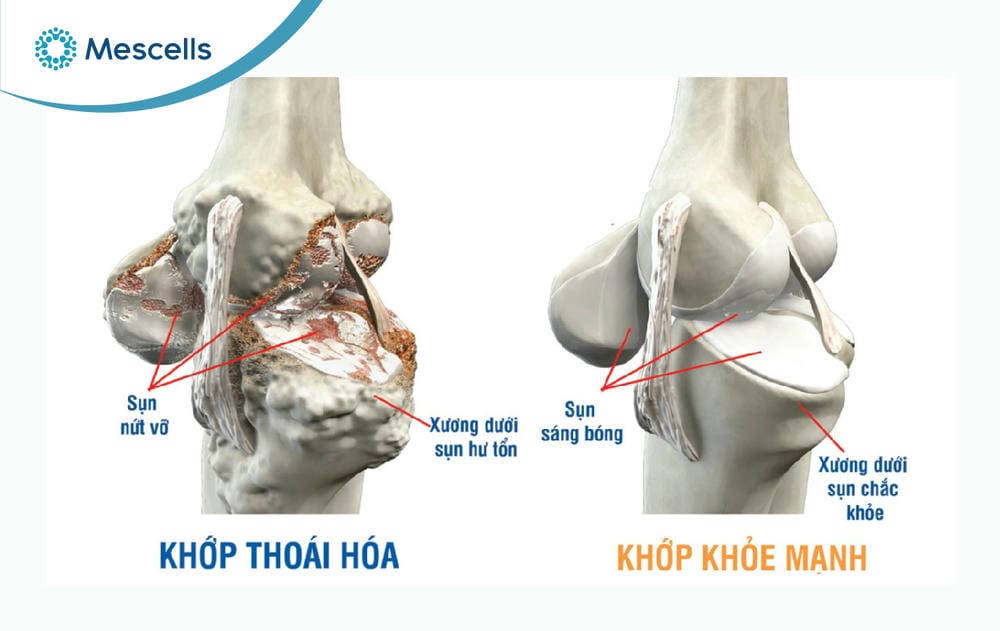
The structure of an osteoarthritic knee with worn cartilage compared with a healthy knee
For decades, conventional treatments for osteoarthritis have served mainly as stopgap measures to control symptoms, without really acting on the root cause of the disease to change the course of degeneration. Typically, patients are prescribed painkillers or non-steroidal anti-inflammatory drugs (NSAIDs), or are given intra-articular injections such as corticosteroids or hyaluronic acid (HA).
Although they bring immediate relief, these solutions have very clear limits. For example, platelet-rich plasma (PRP) injection supplies growth factors from the patient’s own blood to promote healing, but its effect usually lasts only a short time and it is best suited to mild or moderate stages. Hyaluronic acid (HA) injection is essentially the addition of an artificial lubricant to the joint to improve lubrication and reduce friction between the bone ends, with a mild anti-inflammatory effect, but it has no capacity at all for the biological regeneration of lost cartilage.
More worryingly, corticosteroid injection – a very common way of quelling acute inflammatory pain – provides only short-term relief and cannot halt degeneration. When these conservative methods fail, patients often face the last resort of joint replacement surgery, which comes with high costs and a long recovery period.
Against this background, modern medicine urgently needs a new treatment strategy capable of restoring damaged structures at the root. The medical experts at Mescells believe this is where MSC treatment of osteoarthritis demonstrates its importance and great medical value. By harnessing the body’s own remarkable biology, this therapy aims not merely to mask pain but, ultimately, to regenerate cartilage and change the course of this chronic disease.
2. What are mesenchymal stem cells (MSCs) and how do they work in treating osteoarthritis?
To understand MSC treatment of osteoarthritis, we first need to understand the nature of these special cells. Mesenchymal stem cells (MSCs) are adult stem cells that originate from the mesoderm during embryonic development. In the body, MSCs are found everywhere and can be collected from many different tissue sources, such as bone marrow, adipose tissue, the synovial membrane, peripheral blood, umbilical cord tissue and amniotic fluid.
The biological property that sets mesenchymal stem cells (MSCs) apart is their capacity for self-division, self-renewal and multilineage differentiation. This means that, under the right stimulatory signals at the site of injury, they can turn into specialized cells such as cartilage, bone or fat cells to directly compensate for and replace damaged tissue structures.
>>> See also: The potential of stem cells in treating spinal degeneration
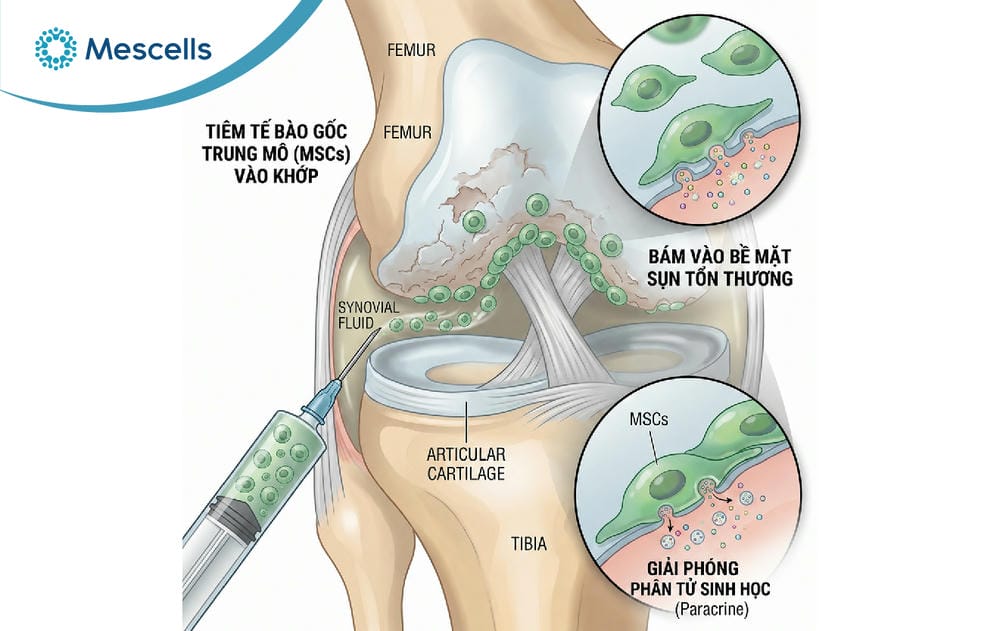
Mesenchymal stem cells (MSCs) are injected into the joint cavity, attach to the cartilage surface and begin releasing biological molecules
At Mescells, we always explain to patients that the benefit of MSC therapy for osteoarthritis goes beyond creating new cells. Its advantage lies in the fact that MSCs act as a “coordination center”, releasing large amounts of bioactive factors, cytokines and growth factors that comprehensively change the environment inside the joint. This regenerative process takes place through three mechanisms:
Regeneration of joint cartilage and chondrogenesis
Mesenchymal stem cells (MSCs) secrete important signaling molecules that promote the differentiation of cartilage cells and increase the synthesis of extracellular matrix (ECM). The key growth factors identified include transforming growth factor beta (TGF-β), platelet-derived growth factor (PDGF) and vascular endothelial growth factor (VEGF).
Specifically, TGF-β plays a key role in enhancing differentiation into cartilage cells and activating the synthesis of type II collagen – the main load-bearing component of joint cartilage – while PDGF promotes cell proliferation and the deposition of extracellular matrix to fill the gaps left by worn cartilage. Thanks to these chemical signals, the cartilage surface gradually regains its structural integrity.
Immunomodulation and control of inflammation
Synovitis is a dangerous factor that plays a central role in joint destruction in patients with osteoarthritis. When introduced into the joint, MSCs respond to the inflammatory environment by directly inhibiting the production of inflammatory cytokines such as interleukin-1 beta (IL-1β) and tumor necrosis factor alpha (TNF-α). This inhibition not only rapidly quells swelling and aching pain, but also protects the cartilage matrix from further breakdown.
Support for regeneration of the subchondral bone
In osteoarthritis, the breakdown of the connection between the cartilage and the bone just beneath it destabilizes the whole joint. By secreting VEGF, which stimulates the formation of new blood vessels, MSCs increase the supply of oxygen and essential nutrients to the damaged area. Thanks to this new vasculature, the interface between bone and cartilage is strongly reinforced and bone marrow edema subsides, restoring the natural load-bearing capacity of the knee joint.
The seamless combination of all three mechanisms is medicine’s comprehensive answer to osteoarthritis.
3. Clinical evidence for the real-world effectiveness of MSC treatment of osteoarthritis
The success of any medical method needs to be demonstrated through real clinical trials and data from use in patients. For MSC treatment of osteoarthritis, a series of reputable studies around the world have recorded very encouraging results.
A large meta-analysis from the renowned scientific organization Cochrane, covering 25 randomized clinical trials with a total of 1,341 participants, highlighted some notable findings. The analysis showed that, compared with placebo injection, mesenchymal stem cells (MSCs) brought a significant improvement in pain and physical function over a follow-up period of up to 6 months after treatment.
>>> Read more: The potential of stem cells in treating herniated discs

A doctor analyzes the patient’s improvement in pain and mobility before and after medical intervention
Specifically, on a 0-10 pain scale, patients who received MSC injections recorded an improvement about 1.2 points better than the placebo group. On a 0-100 scale of joint function, the group receiving stem cells also showed superior recovery, with a difference of 14.2 points compared with the group that did not. Although this improvement is rated as mild to moderate, for patients living with chronic pain it is an extremely meaningful change in their day-to-day mobility.
Alongside these positives, there is another very interesting scientific aspect that the experts at Mescells wish to make clear to readers: “contextual effects”, more widely known as the placebo effect in treatment. Recently, a reputable meta-analysis published in the journal Frontiers in Medicine focused on 8 in-depth clinical trials with 467 patients and discovered an unexpected fact. The researchers found that at 6 months, factors relating to the medical context accounted for as much as 60-63% of the total pain relief and functional improvement that patients experienced.
These contextual factors include the patient’s strong psychological belief in an advanced regenerative technology, a positive doctor-patient relationship, and the mechanical and physical effect of the act of injecting fluid into the joint. Publishing these data in no way denies the real physiological effect of stem cells; on the contrary, it shows that the marked improvement patients feel is the combined result of the specific restorative potential of mesenchymal stem cells (MSCs) and the psychological strength that comes from a professional medical treatment setting.
In commercial practice, MSC treatment of osteoarthritis has changed the lives of tens of thousands of patients. CARTISTEM®, from the MEDIPOST group (South Korea), is the world’s first commercially licensed allogeneic umbilical cord blood-derived mesenchymal stem cell therapy. Since its launch in 2012, more than 36,000 patients with knee osteoarthritis in South Korea have received this therapy, demonstrating its feasibility and high level of safety in mainstream medical practice.
MEDIPOST is currently also conducting Phase III clinical trials in the United States, with the aim of evaluating and extending the use of this cartilage regeneration therapy to the North American market, especially for patients with advanced cartilage defects. Another notable example comes from the company NatureCell with its Jointstem therapy, which uses mesenchymal stem cells obtained from the patient’s own adipose tissue. Long-term clinical follow-up data of up to 5 years for Jointstem have demonstrated its safety and its ability to sustain pain relief and the stability of joint structure, and in particular to significantly reduce the proportion of patients who go on to need knee replacement surgery.
4. Challenges, limits and advice when choosing MSC treatment for osteoarthritis
Although the restorative potential of this approach is enormous, MSC therapy for osteoarthritis still faces many technical and regulatory barriers. The first and most fundamental difficulty is the lack of standardization and consistency in cell extraction and culture worldwide. The source of the mesenchymal stem cells (bone marrow, adipose tissue or umbilical cord blood), the cell concentration used, the centrifugation method and the processing procedures at each laboratory often differ very considerably.
The Emergency Care Research Institute (ECRI) has published a report stressing that this inconsistency makes accurate comparison of clinical efficacy extremely difficult. The organization recommends that the health sector conduct more, larger, multicenter randomized controlled trials to standardize every criterion, from preparation and cell dose to injection technique.
On the regulatory side, health organizations around the world remain very cautious. In the United States, the Food and Drug Administration (FDA) regulates regenerative medicine products to the most stringent standards. To date, the FDA has not formally approved any culture-expanded or biologically modified mesenchymal stem cell (MSC) product for commercial treatment of orthopedic conditions such as osteoarthritis or back pain.
Some autologous stem cell injection therapies carried out as same-day procedures (tissue extraction and immediate re-injection into the patient) may be performed if they meet the FDA’s “minimal manipulation” criterion. However, major medical organizations such as the American College of Rheumatology (ACR) and the American Academy of Orthopaedic Surgeons (AAOS) have not yet issued official guidance adopting stem cell injection as a standard treatment for osteoarthritis, because they are still waiting for more consistent and clearer long-term scientific evidence.
In addition, treatment with mesenchymal stem cells (MSCs) is also a financial consideration for many patients. The initial cost of a course of MSC isolation, culture and injection is usually significantly higher than that of ordinary joint injections, and patients need to prepare financially with care. Nevertheless, in terms of long-term value, this approach may prove more cost-effective because it helps limit the number of repeat injections, controls chronic inflammation and may extend the period over which the joint is preserved, helping patients delay knee replacement surgery, which is more costly and carries more risk.
>>> See also: The potential of stem cells in treating hip osteoarthritis

MSCs are produced in a GMP-compliant laboratory
Faced with a mass of conflicting information, the experts at Mescells advise you to take a balanced view and equip yourself with a sound foundation of scientific knowledge. Stem cell therapy is not a “miracle” that can instantly restore a completely ruined knee joint to its youthful state; it is an achievement of regenerative medicine that requires careful assessment of each individual’s degree of damage.
To ensure complete safety and achieve the best possible result, patients should go only to fully licensed medical centers and clinics specializing in regenerative medicine that have laboratories meeting the required standards, and should be examined by musculoskeletal specialists and given a clear treatment plan before deciding on MSC treatment for osteoarthritis.
MSC treatment of osteoarthritis is offering new hope to patients who want to repair cartilage damage from deep within, using the body’s own healing capacity. With its mechanism of regulating the inflammatory environment and stimulating natural tissue regeneration, MSC therapy stands apart from current measures that focus only on local pain relief.
However, to slow the progression of the disease safely and achieve lasting results, patients need accurate knowledge and should choose reputable medical facilities that meet international standards. With the constant advance of science and technology, the Mescells team is confident that the use of mesenchymal stem cells (MSCs) will soon overcome its current limits and become a standard treatment for osteoarthritis worldwide.
MESCELLS | MSC – SPECIALIZED HEALTHCARE SYSTEM FOR REGENERATIVE MEDICINE AND CELL THERAPY
- Hotline: 0866 022 097
- Address: TT21, No. 204 Nguyen Tuan, Thanh Xuan Ward, Hanoi, Vietnam.
- Fanpage: Mescells Institute of Applied Cell Technology Research
REFERENCES:
- Preprints.org, “Bone Marrow Aspirate Concentrate (BMAC) for Knee Osteoarthritis: A Narrative Review of Clinical Efficacy and Future Directions”. Source: https://www.mdpi.com/1648-9144/61/5/853
- Frontiers, “Contextual effects of mesenchymal stem cell injections for knee osteoarthritis: systematic review and meta-analysis of randomized controlled trials”. Source: https://www.frontiersin.org/journals/medicine/articles/10.3389/fmed.2025.1636181/full
- PR Newswire Asia, “MEDIPOST Inc. Treats First U.S. Participant in Phase III Trial of Umbilical Cord Stem Cell Therapy for Symptomatic Cartilage Defects Due to Knee Osteoarthritis”. Source: https://www.prnewswire.com/apac/news-releases/medipost-inc-treats-first-us-participant-in-phase-iii-trial-of-umbilical-cord-stem-cell-therapy-for-symptomatic-cartilage-defects-due-to-knee-osteoarthritis-302820199.html
- Cochrane Library, “Stem cell injections for osteoarthritis of the knee – Whittle, SL – 2025”. Source: https://www.cochranelibrary.com/cdsr/doi/10.1002/14651858.CD013342/information
Note: The content of this article is compiled from and refers to scientific reports and reputable medical journals around the world. However, this information is for reference only and is not a substitute for diagnosis or specialist medical treatment by a doctor.

Deputy Director, Mescells Institute of Applied Cell Technology Research






 Hotline
 Zalo
Zalo
 Fanpage