 0866 022 097
 institute@mescells.com
What Are Pluripotent Stem Cells? Characteristics and Potential Applications


In the body, stem cells act as an internal repair system that helps keep the number of cells in balance. Stem cells are the foundation cells for every organ and tissue in the body; through division and differentiation they form the specialized cells that make up tissues and organs and carry out specific functions.
Pluripotent stem cells can be used to generate any cell or tissue in the body, allowing scientists to study human development and to build many breakthrough solutions in medical treatment. So what exactly are pluripotent stem cells, and what are their characteristics, types and potential applications? Join Mescells to find out in the following article.
1. What are pluripotent stem cells?
Pluripotent stem cells (PSCs) are stem cells that can self-divide and differentiate into almost every specialized cell type of the body’s three primary germ layers (ectoderm, mesoderm and endoderm), with the exception of extra-embryonic tissues such as the placenta, and thereby form the adult body. Although they cannot form a complete organism as totipotent stem cells can, they are a very important type of stem cell because of their broad differentiation capacity.
2. Characteristics of pluripotent stem cells
The two core properties that define pluripotent stem cells are unlimited self-renewal and pluripotency in differentiation.

Illustration of the two core characteristics of pluripotent stem cells
Self-renewal is one of the defining characteristics of pluripotent stem cells. It allows them to divide indefinitely while remaining in an undifferentiated state. This is very important for maintaining long-term cultures and advancing research on disease regulation, as well as developing therapies.
Using simple biochemical signals or by activating specific signaling pathways, pluripotent stem cells can be developed into different cell types in vitro. This capacity for specialization makes PSCs important in regenerative medicine, as they have the potential to treat diseased or damaged tissues through cell replacement therapies.
3. Common types of pluripotent stem cells
Today, the two most widely studied and applied sources of pluripotent stem cells are embryonic stem cells and induced pluripotent stem cells. The main characteristics of these two cell types are compared in the table below:
| Criterion | Embryonic stem cells (ESCs) | Induced pluripotent stem cells (iPSCs) |
| Origin | The inner cell mass of the early-stage blastocyst | Reprogrammed adult somatic cells (skin, blood, etc.) |
| How they are generated | Isolated directly from surplus embryos after in vitro fertilization | Generated by reprogramming adult somatic cells through the introduction of specific transcription factors such as OCT4, SOX2, KLF4 and c-MYC |
| Similarities | Remain in a pluripotent state, give rise to countless differentiated cells and can self-renew indefinitely under appropriate culture conditions | |
| Ethical issues | Controversial because embryos must be destroyed to obtain the cells | No human embryos are needed, so there is less ethical controversy |
| Potential for personalization | Do not carry the genetic information of a specific recipient | Can be generated from the patient’s own cells, limiting the risk of immune rejection |
Sources for the comparison table: [1], [2].
4. Differentiation capacity of pluripotent stem cells
Under culture conditions controlled by specific growth factors and chemical signals, pluripotent stem cells can be directed to differentiate along each germ layer to produce entirely different specialized cell types [3]:
- The ectoderm can give rise to nerve cells and skin epithelial cells.
- The mesoderm can give rise to heart muscle cells, blood cells, bone cells and cartilage cells.
- The endoderm can give rise to liver cells, insulin-producing pancreatic cells and lung epithelial cells.
Thanks to this capacity, scientists can now grow pluripotent stem cells into three-dimensional models far more complex than a single cell type, known as organoids. These are miniature tissue structures that mimic part of the structure and function of real organs, such as brain, intestinal or liver organoids, and are invaluable for developmental research and drug screening.
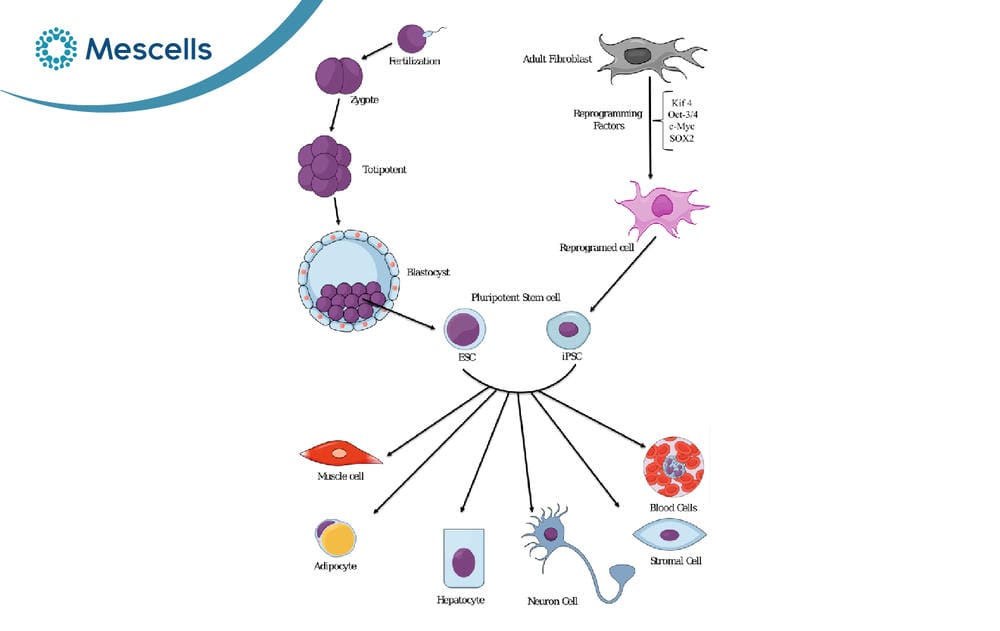
The broad differentiation capacity of pluripotent stem cells
5. Potential applications of pluripotent stem cells
Thanks to their unlimited self-renewal combined with almost complete differentiation potential, pluripotent stem cells are opening up many promising medical applications, although considerable challenges remain before widespread use.
5.1. Regenerative medicine and cell therapy
- Tissue restoration: Pluripotent stem cells can be cultured to produce healthy new cells to replace tissue damaged by heart attack, stroke or diabetes.
- Neurological disorders: Generating replacement nerve cells for research into treatments for conditions such as Parkinson’s disease or spinal cord injury [4].
- Universal transplantation: Developing genetically modified cells able to resist immune rejection in order to treat many degenerative diseases.
5.2. Disease modeling and drug discovery
- Patient-specific models: Turning a patient’s skin or blood cells into stem cells to follow the development of a genetic disease in real time.
- Drug testing: Testing drugs on human cell lines instead of animals to check safety and efficacy.
- Toxicology testing: Observing how specific tissues (such as heart or liver cells) respond to toxins or chemical fumes [4].

Pluripotent stem cells are widely used in regenerative medicine, disease modeling and drug testing
5.3. Advanced immunotherapy
- Cancer-fighting cells: Generating powerful immune cells, such as CAR-T cells, from stem cells with the aim of destroying lymphoma and leukemia.
- Controlling autoimmune disease: Generating specialized regulatory T cells to calm excessive immune responses in rheumatoid arthritis or multiple sclerosis [5].
5.4. Remaining challenges
The greatest safety challenge is the risk of tumor formation [4]. Because pluripotent stem cells by nature proliferate strongly and can differentiate into every tissue type, if even a small number of incompletely differentiated cells remain in a transplant product, they can develop into a teratoma at the transplant site. This is why manufacturing processes for iPSC-derived cell therapies require an extremely rigorous step to remove residual undifferentiated cells before the product is introduced into the human body.
Besides the risk of tumor formation, the use of embryonic stem cells still faces ethical barriers in many countries because it involves the destruction of human embryos. Meanwhile, although iPSCs partly resolve this ethical issue, cell reprogramming and directed differentiation remain costly and time-consuming, and producing a homogeneous target cell population pure enough for clinical use is still a technical problem that has not been fully solved in most laboratories.
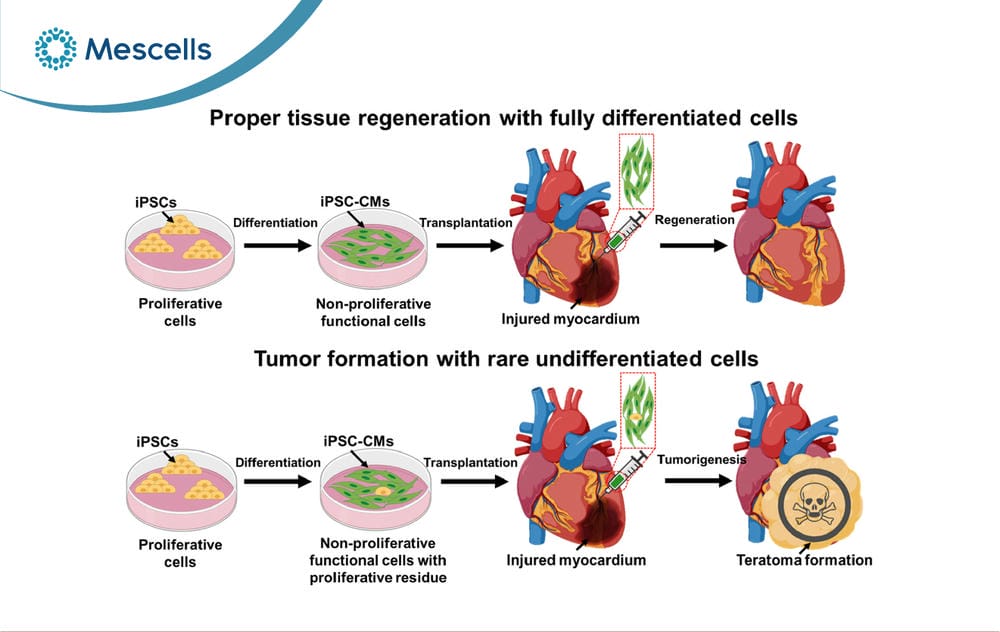
The risk of tumor formation is a major challenge in using pluripotent stem cells to treat disease
It is fair to say that pluripotent stem cells have become one of the most promising tools of modern regenerative medicine. They carry an almost unlimited ability to generate any cell type of the body, while raising safety and ethical questions that science is still working through step by step. A correct understanding of pluripotent stem cells, from their precise definition to the real limits of the technology, is the necessary foundation for a balanced view of both the expectations and the challenges of one of today’s fastest-growing fields of biomedicine.
MESCELLS | MSC – SPECIALIZED HEALTHCARE SYSTEM FOR REGENERATIVE MEDICINE AND CELL THERAPY
- Hotline: 0866 022 097
- Address: TT21, No. 204 Nguyen Tuan, Thanh Xuan Ward, Hanoi, Vietnam.
- Fanpage: Mescells Institute of Applied Cell Technology Research
REFERENCES:
- Antonio Romito, 2015, “Pluripotent Stem Cells: Current Understanding and Future Directions”, PMC, https://pmc.ncbi.nlm.nih.gov/articles/PMC4699068/
- Marisol Aguirre, 2023, “Application of the Yamanaka Transcription Factors Oct4, Sox2, Klf4, and c-Myc from the Laboratory to the Clinic”, PMC, https://pmc.ncbi.nlm.nih.gov/articles/PMC10531188/
- “Pluripotent Stem Cell Differentiation”, Science Direct, https://www.sciencedirect.com/topics/medicine-and-dentistry/pluripotent-stem-cell-differentiation
- Aline Yen Ling Wang, 2025, “Pluripotent Stem Cells: Recent Advances and Emerging Trends”, PMC, https://pmc.ncbi.nlm.nih.gov/articles/PMC12025069/
- Popat Mohite, 2024, “Unlocking the therapeutic potential: odyssey of induced pluripotent stem cells in precision cell therapies”, PMC, https://pmc.ncbi.nlm.nih.gov/articles/PMC11487032/
Note: The content of this article is compiled from and refers to scientific reports and reputable medical journals around the world. However, this information is for reference only and is not a substitute for diagnosis or specialist medical treatment by a doctor.

Deputy Director, Mescells Institute of Applied Cell Technology Research



 Hotline
 Zalo
Zalo
 Fanpage