 0866 022 097
 institute@mescells.com
Treating Cerebral Palsy with Mesenchymal Stem Cells (MSCs): New Hope for Children’s Futures


Cerebral palsy is one of the most common movement disorders in children, caused by non-progressive brain damage during the fetal period or the first years of life. The condition leaves millions of patients and their families facing countless difficulties with daily living, movement and cognitive development throughout life.
At present, conventional therapies largely focus on relieving symptoms and cannot repair the underlying damage to the nervous system. In the face of this challenge, Mescells offers an in-depth look at the treating Cerebral Palsy with Mesenchymal Stem Cells (MSCs) – a promising regenerative approach that is opening a new door of hope.
1. Cerebral palsy and the limits of treatments that do not use mesenchymal stem cells (MSCs)
Cerebral palsy (CP) is the medical term for a group of disabling conditions that affect muscle control, posture and balance. The brain damage usually occurs while the fetus is developing in the womb, during birth, or in the first years after birth, as a result of oxygen deprivation, infection or neonatal stroke.
According to global medical statistics, cerebral palsy occurs in about 2.1 per 1,000 live births. Whatever the cause, the painful truth is that once nerve cells die and their connections are broken, the patient loses the ability to move normally. Severity varies widely, from slight difficulty moving to complete paralysis with an inability to eat or communicate independently, accompanied by cognitive disorders and epilepsy.

Comparison of the brain’s neural network in a healthy child and a child with cerebral palsy
Mescells’ experts want you to understand that, to this day, conventional medicine still has no complete cure for this condition. When a child is diagnosed with cerebral palsy, the standard regimen usually revolves around physical therapy, occupational therapy and speech therapy, combined with drugs to reduce muscle spasticity (such as botulinum toxin) or orthopedic surgery.
However, these methods all share one very large limitation: they work only at the “surface”, helping patients adapt and control physical symptoms, and cannot reach the “root” by regenerating the damaged area of the brain. Moreover, regular medication often comes with worrying side effects, while surgery brings considerable pain and risk. It is precisely this impasse in the search for a way to reverse nerve damage that has led scientists to turn to regenerative medicine, paving the way for stem cell technology.
2. What are mesenchymal stem cells (MSCs) and why are they used in treating cerebral palsy?
To explain it as simply as possible, Mescells often likens the body’s stem cells to skilled builders and doctors. Among them, mesenchymal stem cells (MSCs) are a particularly important branch. They are multipotent adult stem cells, meaning they can change and develop into several different cell types that make up the body’s basic tissues, such as bone, cartilage and fat. Scientists can readily collect and isolate MSCs from many abundant and minimally invasive sources, typically bone marrow, adipose tissue, umbilical cord tissue, or even the dental pulp of children’s baby teeth.

Mesenchymal stem cells (MSCs) have strong potential for medical application
But why not use neural stem cells to repair the brain, rather than favoring mesenchymal stem cells? In theory, neural stem cells can regenerate the brain directly, but obtaining and using them requires extremely dangerous surgery on the brain or spine, and runs into many barriers relating to bioethics and the risk of rejection. Mesenchymal stem cells (MSCs), by contrast, are the leading candidate because they are far safer. MSCs have very low immunogenicity, meaning that when introduced into a patient’s body they are unlikely to be recognized by the immune system as foreign and attacked.
In particular, MSCs can be expanded in large numbers in the laboratory to reach a standard therapeutic dose. When infused into the body, usually intravenously, these cells act like a flexible rescue team, able to home to areas of the brain that are inflamed or damaged. Good tolerability, a high level of safety and a multitasking mechanism of action have made the treatment of cerebral palsy with mesenchymal stem cells (MSCs) one of the fastest-growing areas of research in the world today.
3. The science behind treating cerebral palsy with mesenchymal stem cells (MSCs)
Drawing on its expertise in cells, Mescells wishes to emphasize that mesenchymal stem cells (MSCs) do not work by turning directly into brain cells (neurons) to replace dead brain tissue, because the blood-brain barrier is very difficult to cross. Instead, the secret behind the effectiveness of MSCs in cerebral palsy lies in the following three remarkable molecular biological mechanisms.
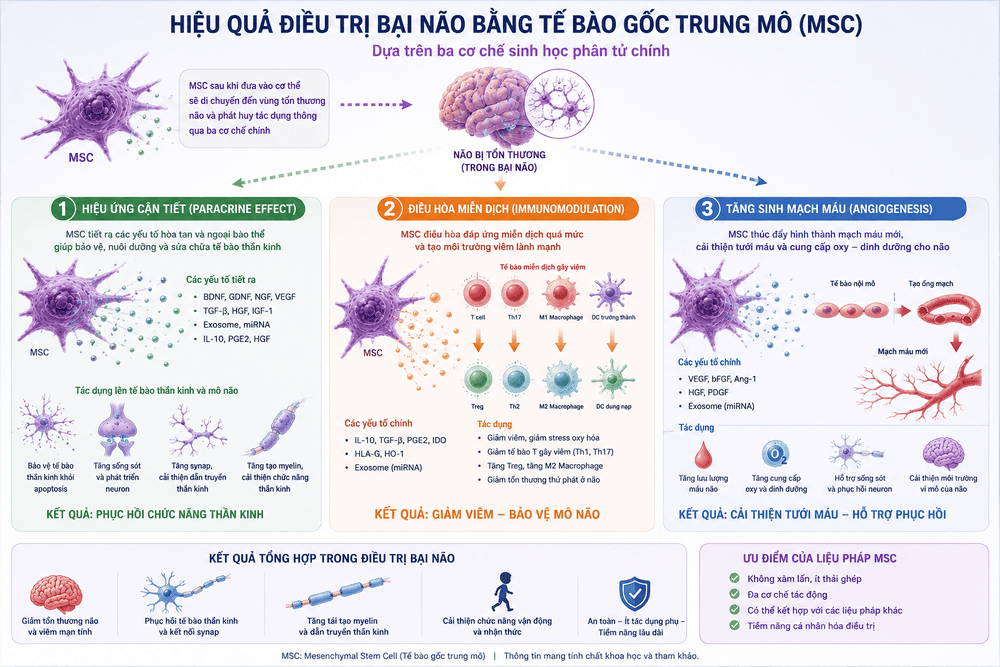
The effectiveness of mesenchymal stem cells (MSCs) in cerebral palsy comes from three molecular biological mechanisms
3.1. The first and most important mechanism is the paracrine effect
Picture MSCs as a tiny but highly sophisticated chemical factory. Once inside the body, they continuously secrete a range of potent bioactive substances, including neurotrophic factors, cytokines and anti-inflammatory molecules. These compounds act like a suit of armor, protecting brain cells that are barely surviving from dying, while awakening the patient’s own endogenous nerve cells to repair themselves.
A notable recent study by Kanzawa and colleagues (2026) tested intravenous injection of mesenchymal stem cells from the dental pulp of baby teeth (SHED) in models of chronic-stage cerebral palsy. The results showed that these MSCs secreted large amounts of hepatocyte growth factor (HGF) – a protein that plays a key role in stimulating the proliferation of endogenous neural stem cells. Thanks to this HGF, the formation of new nerve cells (neurogenesis) in the hippocampus and cerebral cortex was strongly promoted, helping to restore motor and learning functions that had been impaired for a long time.
3.2. The second mechanism is immunomodulation
Cerebral palsy is often accompanied by lingering inflammation in the central nervous system, caused by the body’s excessive immune response to the original injury. Mesenchymal stem cells (MSCs) are able to suppress the activation of inflammatory cells, calming the microenvironment in the brain. They shift the brain from a state of being “on fire” to a state of “healing”, creating optimal conditions for the recovery of neural networks.
3.3. The third mechanism is angiogenesis
To repair any tissue, the body needs blood to deliver oxygen and nutrients. MSCs secrete factors that stimulate the formation of new blood vessels, helping to re-establish a stable blood supply to brain tissue that was once ischemic, and thereby improving overall brain function in a lasting way.
4. Real-world evidence and clinical trials of mesenchymal stem cells (MSCs) for cerebral palsy
Scientific theory is the foundation, but real-world results are the clearest proof. Mescells’ experts are pleased to report that the treatment of cerebral palsy with mesenchymal stem cells (MSCs) has undergone a series of rigorous clinical trials in humans and has produced very encouraging signals.

Mesenchymal stem cell therapy combined with physical therapy is effective in treating cerebral palsy
In a meta-analysis published in 2020 in the journal Neurology Asia, scientists pooled data from seven randomized controlled trials involving a total of 411 children with cerebral palsy. The analysis showed that children treated with stem cell therapy had markedly and significantly greater improvement in Gross Motor Function Measure (GMFM) scores than those who received physical therapy alone. The GMFM is the gold-standard medical tool for assessing the ability of children with cerebral palsy to roll, crawl, sit, stand and walk.
A typical example is the study by Dr. Liu and colleagues (2017), who compared the effectiveness of bone marrow mesenchymal stem cells (BM-MSCs) with bone marrow mononuclear cells. The results showed that the group receiving mesenchymal stem cells (MSCs) achieved a much greater improvement in motor function, demonstrating the superiority of this cell type in neural regeneration. Similarly, studies by Huang (2018) and Gu (2020) using umbilical cord-derived mesenchymal stem cells (UC-MSCs) given by intravenous infusion also recorded a clear increase in gross motor scores after just 6 to 12 months of follow-up.
Safety is always the top priority. You can be reassured that, in all the clinical trials mentioned above, serious adverse effects were very rare and occurred at a rate similar to that in the groups that did not receive cells. Some mild, transient side effects such as low-grade fever, nausea or rash occasionally appeared right after cell infusion, but they usually resolved quickly without leaving any lasting effects.
Under the “traffic light” system for rating medical evidence developed by Novak and colleagues in 2021, mesenchymal stem cell (MSC) therapy was placed in the “yellow light” category – meaning an approach with promising trial evidence that is safe and offers real hope of improving motor function for the patient community.
5. Future directions for treating cerebral palsy with mesenchymal stem cells (MSCs)
Although current results are very encouraging, Mescells must also say frankly that regenerative medicine is still maturing. One of the greatest challenges for MSC treatment of cerebral palsy today is the lack of uniformity in cell manufacturing. Because sources vary (umbilical cord, bone marrow or baby teeth) and each laboratory’s culture technology is different, the number and quality of cells across trials have not yet reached a single absolute standard.

The fruits of basic scientific research are opening up a new future for the treatment of cerebral palsy
In addition, the ideal cell dose and the optimal window for intervention remain questions that will take more time to answer. Some studies, such as that by Sun and colleagues (2021), have indicated that patients who receive higher cell doses (over 20 million cells/kg of body weight) tend to show stronger motor recovery. Experts also predict that infusing stem cells earlier after brain injury will be more effective, by making the most of the very powerful anti-inflammatory mechanism of mesenchymal stem cells.
In the future, Mescells believes the best approach will not be stem cells alone, but a seamless combination of cell therapy and intensive physical therapy exercises to consolidate newly formed neural connections. Large-scale Phase III clinical trials under way around the world will soon deliver standardized protocols, turning this biotechnology from an experimental therapy into an official standard of care.
Overall, treating cerebral palsy with mesenchymal stem cells (MSCs) is being recognized by global medicine as a breakthrough, safe approach that brings significant improvements in motor function for patients. Although it cannot yet be regarded as a miracle that instantly cures every disability, the biological effects of mesenchymal stem cells (MSCs) genuinely help protect, reduce inflammation in and regenerate damaged neural networks effectively at the microscopic level.
Evidence from current clinical trials has strengthened patients’ confidence and laid a solid foundation for research to standardize medical procedures in the near future. Through the expert perspective of Mescells, we hope you have gained a clear, scientific and optimistic understanding of the great potential of this advanced cell technology.
MESCELLS | MSC – SPECIALIZED HEALTHCARE SYSTEM FOR REGENERATIVE MEDICINE AND CELL THERAPY
- Hotline: 0866 022 097
- Address: TT21, No. 204 Nguyen Tuan, Thanh Xuan Ward, Hanoi, Vietnam.
- Fanpage: Mescells Institute of Applied Cell Technology Research
REFERENCES:
- Sun JM, et al. Sibling umbilical cord blood infusion is safe in young children with cerebral palsy. Stem Cells Transl Med. 2021. https://doi.org/10.1002/sctm.20-0470
- Poh TE, et al. Stem cell therapy in improving the motor function of patients with cerebral palsy: Systematic review with meta-analysis. Neurology Asia. 2020. https://www.neurology-asia.org/articles/neuroasia-2020-25(4)-535.pdf
- Novak I, et al. Research update on the state of the evidence for stem cell and regenerative medicine in cerebral palsy. Archives of Stem Cell and Therapy. 2021. https://doi.org/10.46439/stemcell.2.010
- Kanzawa T, et al. Novel Stem Cell Therapy for Cerebral Palsy Using Stem Cells from Human Exfoliated Deciduous Teeth. Stem Cell Research & Therapy. 2026. https://link.springer.com/article/10.1186/s13287-025-04828-y
- Ren J, et al. Efficacy and Safety of Interventions for Cerebral Palsy: An Umbrella Review of 35 Meta-analyses. Global Meta-Analysis Journal. 2026. https://www.gmetajournal.com/index.php/gmaj/article/view/4
Note: The content of this article is compiled from and refers to scientific reports and reputable medical journals around the world. However, this information is for reference only and is not a substitute for diagnosis or specialist medical treatment by a doctor.

Deputy Director, Mescells Institute of Applied Cell Technology Research




 Hotline
 Zalo
Zalo
 Fanpage