 0866 022 097
 institute@mescells.com
Ethics in Stem Cell Research: The Journey Towards a Humane Future for Medicine


In the golden age of biotechnology, stem cell research has risen to become one of the most important pillars of modern medicine, kindling hope of reversing incurable diseases once regarded as a “death sentence”. Yet this remarkable progress is not confined to technical achievements; it has also opened up heated debate about the boundaries of ethics in stem cell research.
Those affected by this revolution are not limited to the scientific community or patients waiting for a chance at life; they include the whole of society as it shapes the norms of the future. The most sustainable solution is to establish a dynamic balance between technological innovation and core ethical values, in which research always takes humanity as its guiding principle.

The rights of stem cell donors are protected by the biomedical legal framework and international ethical standards
1. Stem cells and the foundation of modern biomedical research
Stem cells are not merely a biological tool; they represent the “primordial language” of life, allowing us to decode the complex mechanisms of differentiation and embryonic development. Understanding stem cells is a strategic step towards the era of personalized medicine, in which treatment is not based on general protocols alone but is fine-tuned to each genome.
According to the scientific foundations set out by Devolder and Ziemba, stem cells are defined by two core properties: self-renewal, which maintains the cell population, and differentiation into functionally specialized cell types. The evolution of this technology has passed through important milestones:
- Embryonic stem cells (hESCs): Derived from the inner cell mass of the blastocyst, they are fully pluripotent but face ethical barriers because their collection involves the destruction of embryos.
- Induced pluripotent stem cells (hiPSCs): This was a revolutionary advance, in which scientists use the “Yamanaka factors” (OCT4, SOX2, KLF4 and c-MYC) to reprogram adult somatic cells back to a pluripotent state. The technique not only resolves the ethical problem of human embryos but also paves the way for autologous regenerative medicine.

The culture of induced pluripotent stem cells (hiPSCs) helps overcome the ethical barriers of embryonic stem cells
Against this background, pioneering organizations such as Mescells have worked to establish safe research standards, ensuring that every culture and differentiation process complies with the most stringent technical safeguards. Standardizing cell sources helps optimize therapeutic efficacy while minimizing potential biological risks.
Key applications of stem cells include:
- Tissue and organ regeneration: Repairing damage caused by myocardial infarction or neurodegeneration, or replacing skin tissue after extensive burns.
- Toxicity testing and drug screening: Creating human cell models to predict pharmacological responses, gradually replacing less accurate animal models.
- Research into disease mechanisms: Building disease cell lines to gain a deeper understanding of cancer and rare genetic disorders.
As our ability to intervene reaches deeper into the basic structure of life, our ethical responsibility multiplies accordingly. The ability to modify and combine cell lines is bringing humanity closer to new ontological boundaries.
2. Boundaries in creating and using chimeras
The intersection of human and animal cells in the laboratory has moved from philosophical hypothesis to biomedical reality. The creation of chimeras is now seen as a strategy for addressing the global organ shortage crisis through the technique of blastocyst complementation.
According to Katrien Devolder, a chimera is an organism formed by mixing whole cells from genetically different organisms. A clear distinction needs to be made between:
- Intraspecific chimeras: Cells from the same species are combined (for example, transplanting mouse retinal cells into an adult mouse).
- Interspecific chimeras: Human cells are introduced into the embryo or body of an animal of another species (usually pigs, sheep or primates).
The strategic value and impact of chimera research lie in the possibility of generating “personalized” human organs inside a host animal. By using the patient’s own hiPSCs, we could grow a compatible kidney or liver, completely eliminating the risk of immune rejection. However, blurring the ontological boundaries between species raises deep concern about “disrupting the natural order”. The public worries that introducing human cells into animals could lead to an irreversible degree of “humanization” of other species, blurring the very boundary that defines what it is to be human.
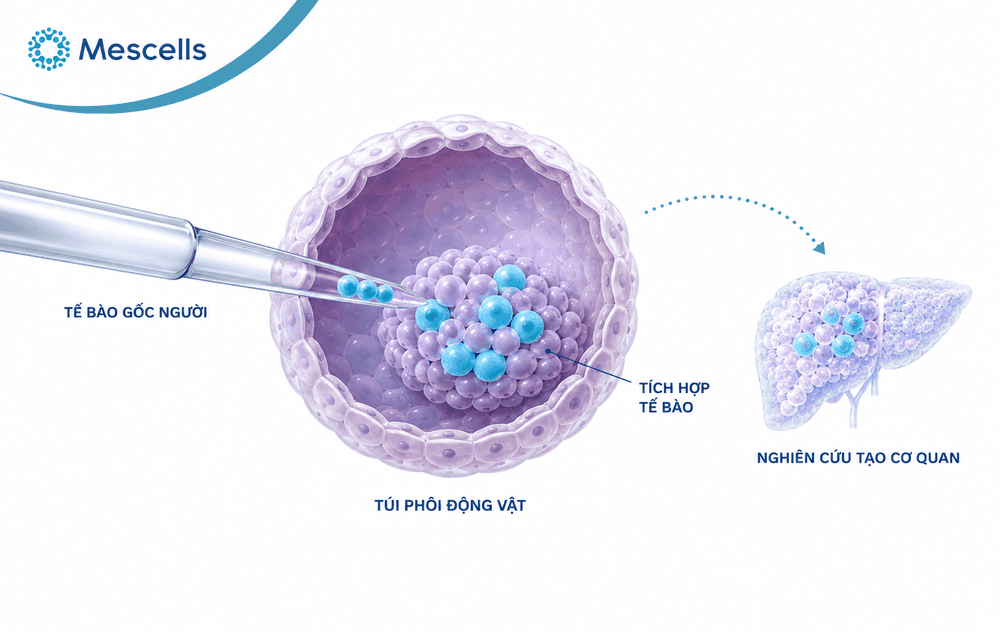
Modeling the integration of human pluripotent stem cells into an animal blastocyst (blastocyst complementation) for organ regeneration research
The question here is not only what we can do, but whether we are creating entities with “humanity” in an animal body.
3. The boundary of human dignity and the question of cognitive capacity
In bioethical theory, “human dignity” is an absolute constant. It requires that any entity possessing dignity be treated as an end in itself, rather than as a means to serve research.
Based on the analysis of Devolder and colleagues, one real risk is that human stem cells may enter and contribute to the central nervous system of the host animal. If these cells differentiate into functional neurons and take part in higher neural networks, the possibility of “humanizing” the animal’s cognition is a risk that cannot be ignored. This is the state of “moral confusion” that Robert and Baylis warned of.
A deeper analysis of “the dilemma of dignity” shows that chimera research places us in a logical and philosophical bind:
- If chimeras do not have dignity, creating them would not appear to violate the highest norms, much like ordinary animal husbandry. However, if they have human-like morphological features, this could weaken the psychological link in society between “human form” and “human dignity”.
- If chimeras do have dignity, we are creating a being with interests equivalent to those of a human while planning to use them as a source of donor organs. That is a serious ethical violation.
| Possibility | Ethical consequence | Practical rule of conduct |
| Has dignity (based on cognition) | Entitled to absolute protection; must not be violated. | Treated as a child research subject; organs must not be taken. |
| Does not have dignity | Falls under the ordinary animal welfare framework. | May be used in research under strict oversight. |
To address this problem, Julian Savulescu has proposed a principle: where there is uncertainty, a chimera should be accorded the highest moral status consistent with its potential nature.
4. The ethical challenge in stem cell research and reproduction
One of the most sensitive aspects is the possibility that human stem cells may contribute to the reproductive system of the host animal, producing gametes (eggs or sperm) that carry human genetic information.
The “yuck factor” (an instinctive reaction of disgust) often arises when the public imagines a chimera producing human germ cells. Although Leon Kass argues that this repugnance is the “wisdom of intuition” warning against the violation of sacred values, ethicists such as Palacios-González hold that the matter should be considered on the basis of practical benefits:
- Addressing the shortage of eggs for regenerative research.
- Reducing medical risks for women who would otherwise undergo complex egg donation procedures.
- Opening up the possibility of restoring fertility for patients whose reproductive organs have been damaged by disease or accident.
To allay concerns about the creation of second-generation hybrids, science has put forward technical solutions to prevent unintended reproduction: sterilizing embryos, strict segregation by sex, or creating chimeras of only one sex within a facility. The journey towards the future is not only about resolving controversies but also about finding more humane alternatives.
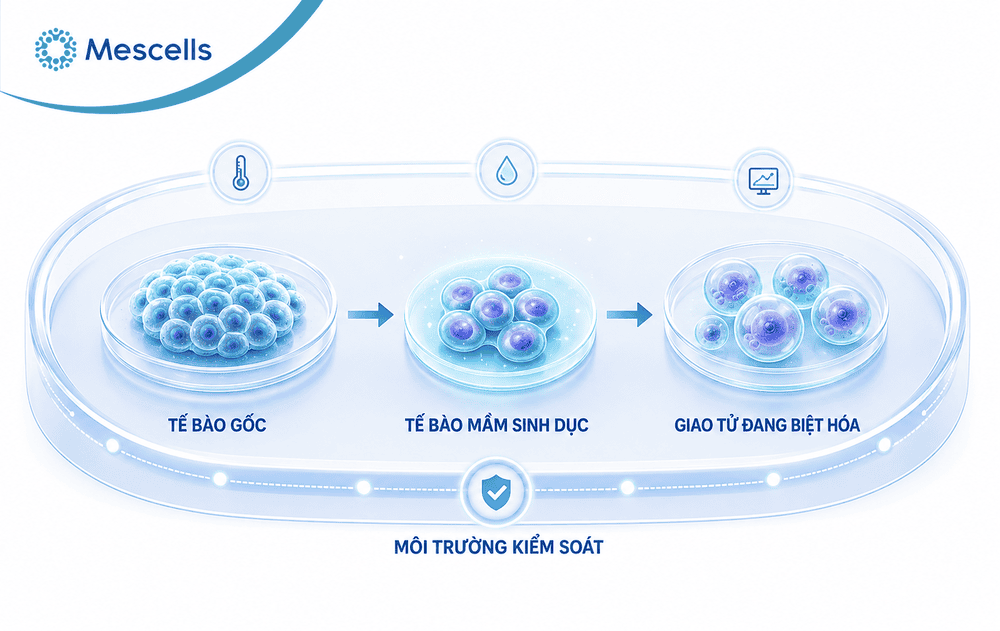 Illustration of the differentiation of stem cells into human gametes (germ cells) in a controlled environment
5. hiPSCs and humane alternative models
The strategic shift from embryonic stem cells to hiPSCs demonstrates that ethics in stem cell research can drive technological innovation. Using hiPSCs not only removes the need for human embryos but also underpins New Approach Methodologies (NAMs).
According to Barbara Ziemba (2025), the combination of hiPSCs and organ-on-a-chip technology is redefining cytotoxicity testing. Instead of relying on animal models with high error rates due to species differences, scientists now use Integrated Approaches to Testing and Assessment (IATA) to obtain accurate data from human cells.
The 3Rs principle and the superiority of NAMs:
- Replacement: Using in silico models (computer simulation) and organ-on-a-chip to completely replace animal tests that cause considerable suffering.
- Reduction: Initiatives such as Tox21 and ToxCast use quantitative high-throughput screening (qHTS) to test thousands of compounds at once on 1536-well plates, reducing the amount of sample and the number of cells required.
- Refinement: Using microchips to simulate physiological flow and tissue interactions, yielding data that are more predictive for human health.
In these projects, computerization and multiparametric analysis have turned the measurement of cell viability into a “counterscreen” rather than the sole endpoint. This allows organizations such as Mescells to identify subtle adaptive cell responses before the cells progress to irreversible death, helping to optimize the safety of pharmaceuticals.
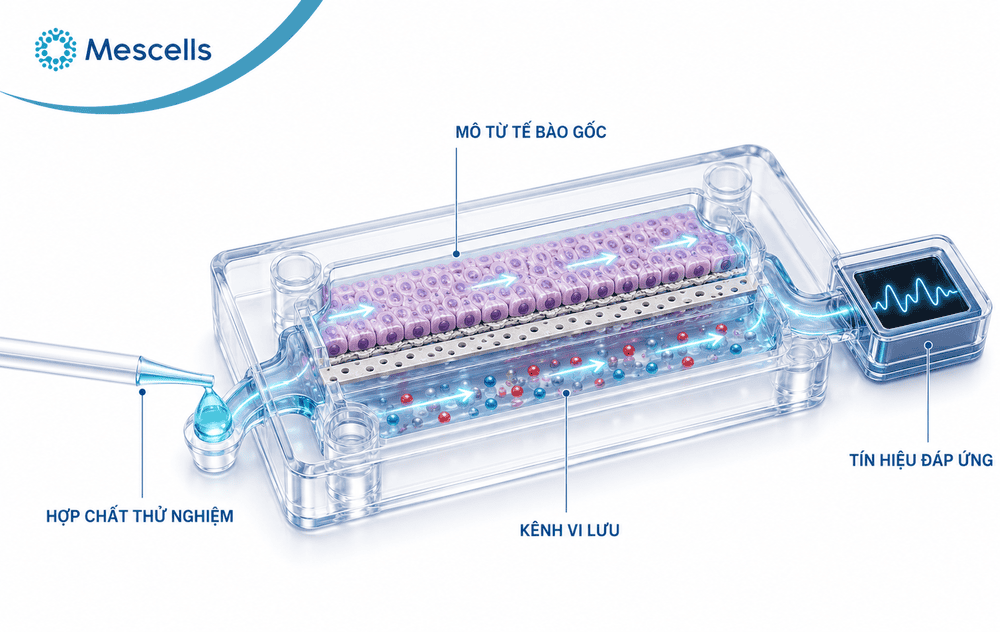
A microfluidic device that mimics human organ function (organ-on-a-chip), using pluripotent stem cells for drug testing
6. The legal framework and international standards for ethics in stem cell research
Science cannot operate in a legal vacuum. To ensure transparency, international organizations have established strict frameworks.
The ISSCR guidelines (2021) and the recommendations from Ziemba’s research set out the rules of Good Cell Culture Practice:
- Donor consent: Strict compliance with the Declaration of Helsinki (2013) on ethics in biomedical research and EU Directive 2004/23/EC on standards for cell donation.
- Multi-level oversight: Research must be reviewed by local and national ethics committees, particularly where embryonic stem cells or chimeras are involved.
- Data transparency: Applying the FAIR principles (Findable – Accessible – Interoperable – Reusable) to genetic datasets to prevent misuse of personal information.
Research and application organizations such as Mescells always treat compliance with the regulations of the Ministry of Health and of bodies such as the FDA/EMA as their foundation. Maintaining transparency is not only a legal requirement but also a way of building public trust in the power of science.
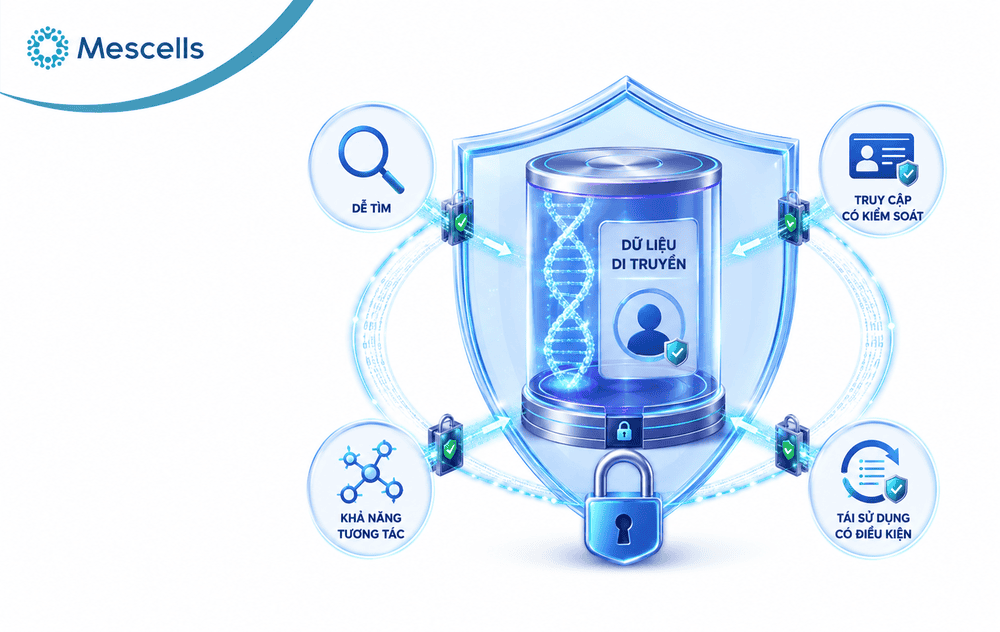
Complying with the FAIR principles in storing and securing the genetic data of cell donors is one of the ethical requirements in stem cell research
Stem cell research is bringing us to the threshold of a new era of medicine, in which humanity is able to rebuild itself from the cellular level. But the greater the power, the greater the responsibility. We have seen that ethics in stem cell research is not a brake on progress but the compass that keeps science from straying from humane values.
Persevering with new approaches such as hiPSCs and NAMs, together with close oversight by the community, will ensure that every step forward in research is a step towards sustainable human progress. In the world of the future, medicine will not be merely the sum of biochemical reactions, but a symbol of respect for life in all its forms of being.
MESCELLS | MSC – SPECIALIZED HEALTHCARE SYSTEM FOR REGENERATIVE MEDICINE AND CELL THERAPY
- Hotline: 0866 022 097
- Address: TT21, No. 204 Nguyen Tuan, Thanh Xuan Ward, Hanoi, Vietnam.
- Fanpage: Mescells Institute of Applied Cell Technology Research
REFERENCES:
- The Ethics of Creating and Using Human-Animal Chimeras. Katrien Devolder, Lauren J Yip, Thomas Douglas. 2019. ILAR Journal, Volume 60. https://doi.org/10.1093/ilar/ilaa002 .
- Advances in Cytotoxicity Testing: From In vitro Assays to In silico Models. Barbara Ziemba. 2025. Preprints.org. https://doi.org/10.20944/preprints202510.1961.v1 .
- Guidelines for Stem Cell Research and Clinical Translation. International Society for Stem Cell Research (ISSCR). 2021. https://www.sciencedirect.com/science/article/pii/S2213671121002630
- Toxicity Testing in the 21st Century. U.S. National Research Council. https://www.nationalacademies.org/read/11970/chapter/1
- Declaration of Helsinki (2013) – Ethical Principles for Medical Research Involving Human Subjects. World Medical Association. https://www.wma.net/wp-content/uploads/2024/10/DoH-OCT2013.pdf
- EU Directive 2004/23/EC on setting standards of quality and safety for the donation, procurement, testing, processing, preservation, storage, and distribution of human tissues and cells. https://op.europa.eu/en/publication-detail/-/publication/1589d23a-1fd2-40aa-83cb-b8641cb53165/language-en
Note: The content of this article is compiled from and refers to scientific reports and reputable medical journals around the world. However, this information is for reference only and is not a substitute for diagnosis or specialist medical treatment by a doctor.

Deputy Director, Mescells Institute of Applied Cell Technology Research


 Hotline
 Zalo
Zalo
 Fanpage