 0866 022 097
 institute@mescells.com
Stem Cell Cryopreservation Technology: A Solution for Preserving Biological Insurance


In the unchanging flow of time, aging and illness are natural laws that people must always face with some degree of anxiety. For individuals and families seeking a lasting way to protect their health, proactively preserving their own most precious biological “capital” is a strategic and far-sighted decision. Stem cell cryopreservation technology today is no longer merely a laboratory technique; it has truly become a biological “time machine” that lets us freeze life in its purest and most vigorous state. In the article below, Mescells explores the role of this method in preserving a source of cells for future healthcare needs.
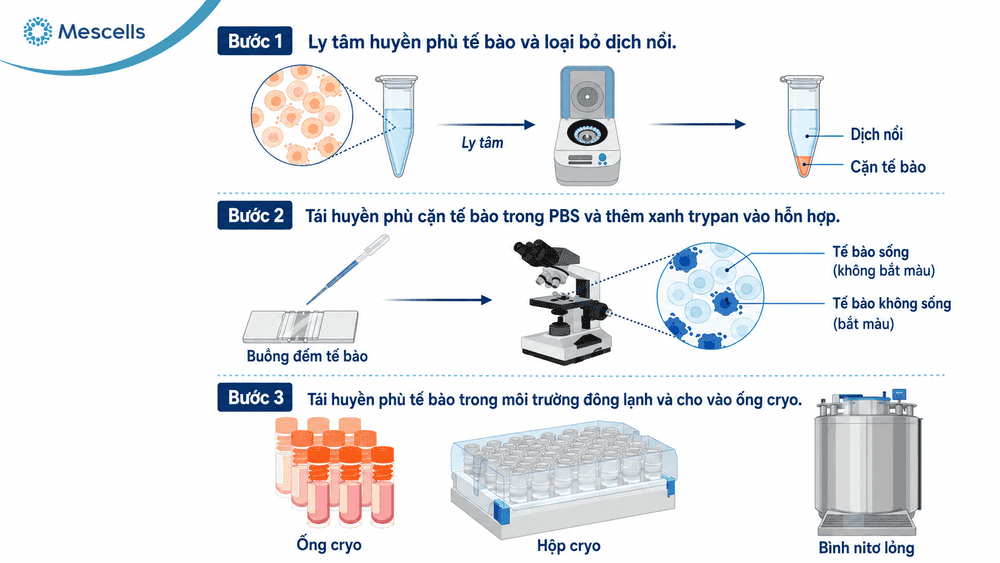
The stem cell cryopreservation process
1. Why is stem cell cryopreservation technology needed?
In the era of regenerative medicine, stem cells are likened to the very first “building blocks”, with the versatile ability to self-renew and differentiate into specialized cells that repair damage deep inside the body. Successfully collecting stem cells is only half the journey. Their real value lies in the ability to retain intact biological activity over decades, and this depends entirely on a precise storage process.
Stem cells are extremely sensitive living entities. At room temperature or in an uncontrolled environment, cellular metabolism continues without interruption. The result is an accumulation of toxic by-products and rapid intracellular aging, causing the cells to lose their ability to proliferate and differentiate – their most valuable properties. Each cell sample is not just a dry unit of biological data, but the hope and peace of mind of an entire family. Stem cell cryopreservation technology that “pauses” life is therefore an absolute requirement.
Storage is not just about keeping a sample; it is about protecting a priceless biological asset. By placing cells into a perfect state of “hibernation”, we can protect their therapeutic potential from the ravages of time, ready for breakthrough medical applications in the future.

Applications of stem cell cryopreservation technology
2. How stem cell cryopreservation technology works
To keep cells alive for decades, we need to bring them into a state in which all metabolic activity and biochemical reactions come to an almost complete stop. This is “hibernation” at the molecular level. The key to the process is deep cooling to -196°C in liquid nitrogen.
The greatest challenge for a bioengineer in this process is the formation of ice crystals. As the temperature falls, water in the cell tends to crystallize. These ice crystals, sharp as microscopic “needles”, can puncture the cell membrane or destroy vital organelles, causing irreversible damage. To solve this problem, the cooling rate must be precisely controlled.
Cooling follows a strict schedule: not so fast as to cause thermal shock and massive ice formation, and not so slow as to cause excessive dehydration due to osmotic pressure. Once an extremely low temperature is reached, all molecular activity is “frozen” and the cell enters a state of absolute stability. This is the scientific basis that allows us to awaken this “seed of life” at any time in the future with its vitality fully intact.
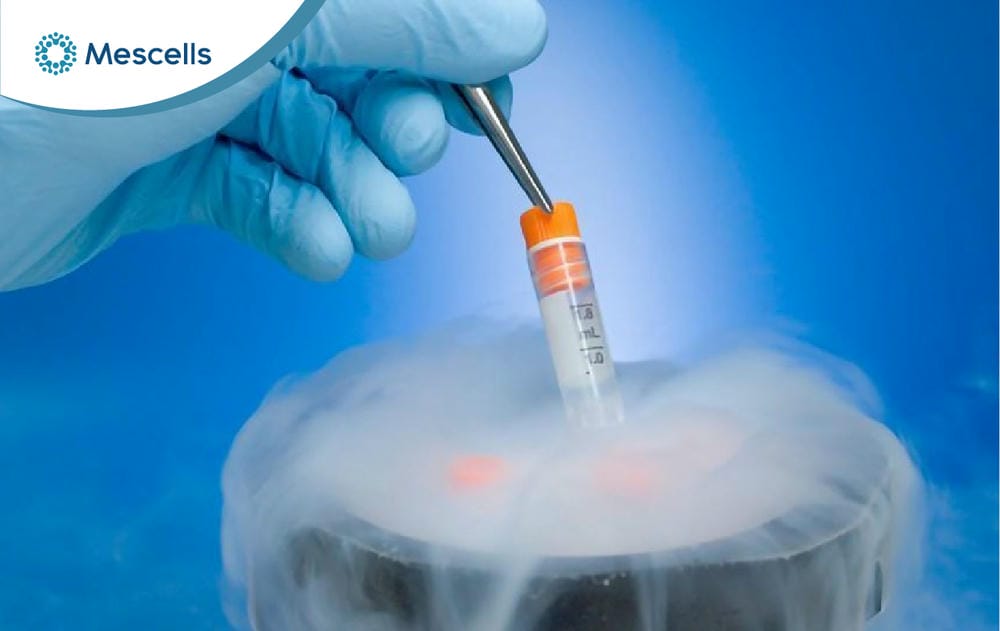
Stem cell cryopreservation technology uses liquid nitrogen at an ultra-low temperature of -196°C to pause all biochemical reactions
3. Two methods of stem cell cryopreservation
The development of stem cell cryopreservation technology reflects the biomedical field’s constant efforts to optimize cell survival rates.
3.1. Slow freezing
Slow freezing is the traditional technique, using a programmable controlled-rate freezer. The temperature of the cells is lowered gradually, typically by 1°C per minute. Although this method is highly stable and has been proven over many decades, some risk of ice crystal formation remains, especially with extremely sensitive cell types.
3.2. Vitrification
Vitrification is regarded as a revolutionary leap. Instead of allowing the solution to crystallize, this technique uses an appropriate concentration of cryoprotectant combined with an extremely fast cooling rate to turn the solution surrounding the cells into an amorphous, glass-like solid.
This method completely eliminates ice crystal formation. In in-depth research, we apply supporting techniques such as the “Open Pulled Straw” (OPS) method or the use of ultra-fine glass tubes to maximize the heat-exchange surface area, ensuring an optimal cell recovery rate.
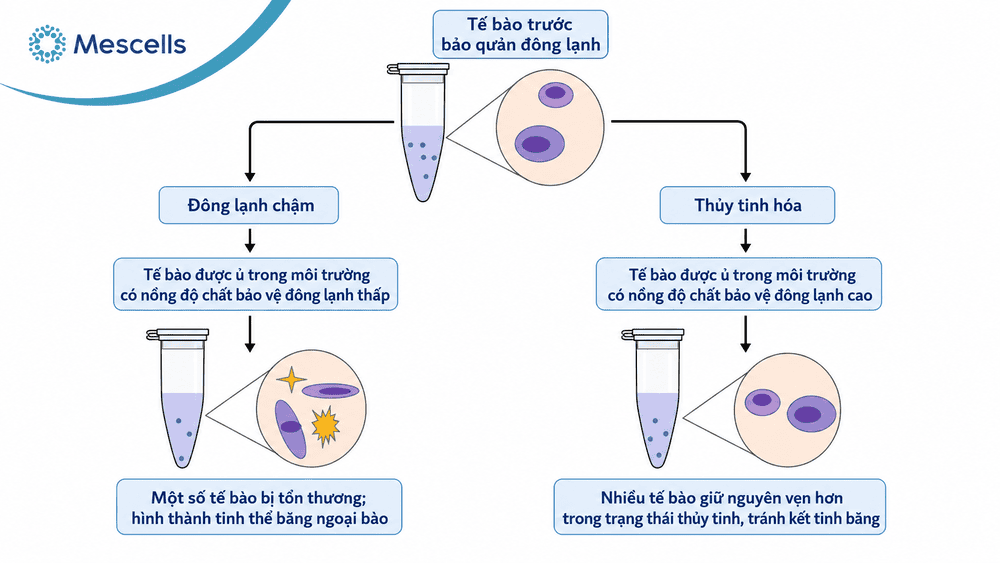
Diagram illustrating the difference between slow freezing and vitrification
Below is a comparison table based on research data for human embryonic stem cells (hESCs):
| Criterion | Slow freezing | Vitrification |
| Cooling rate | Slow, program-controlled | Ultra-rapid |
| Ice crystal formation | Risk of formation | None at all |
| Viability – for hESCs | About 22.8% (according to the MedNexus study) | Very high, reaching 89.7% |
| Technical complexity | Requires complex cooling equipment | Requires extremely fast and precise manual handling skills |
4. Stem cell cryopreservation technology: DMSO and DMSO-free
Cryoprotectants act as chemical “bodyguards”, protecting the cell membrane throughout the freezing process. For decades, 10% dimethyl sulfoxide (DMSO) has been the gold standard. However, as specialists who always put patient safety first, we cannot ignore the potential side effects of DMSO, such as nausea, cardiac arrhythmia or allergic reactions, when cells are thawed and transplanted into the body.
To address this, modern biomedicine has developed DMSO-free solutions. One of the “golden formulas” attracting worldwide attention is a combination of 3% trehalose and 5% dextran 40 in lactated Ringer’s solution (LR-3T-5D). In addition, studies have shown that supplementing with propylene glycol (PG) at an optimal concentration of 2.5% to 5% gives thawed cells a proliferation and differentiation capacity equivalent to that of fresh cells (fresh hADSCs).
DMSO-free solutions not only eliminate toxicity but also maintain the “stemness” of stem cells, avoiding unwanted differentiation during storage.
5. Clinical applications and benefits of high-quality stem cell storage
Stem cell storage is no longer a story of the future, but a powerful medical reality. Today, stem cells from umbilical cord blood have been approved for the treatment of more than 80 different conditions, including blood diseases (leukemia, bone marrow failure), immune system disorders and inborn metabolic diseases.
In regenerative medicine, mesenchymal stem cells (MSCs) are widely applied in treating osteoarthritis and spinal injury and in tissue rejuvenation. In particular, the combination of stem cells and immune cells is opening new chapters in the fight against cancer. Cells collected at birth, or when the body is at its healthiest, have the most vigorous biological activity.
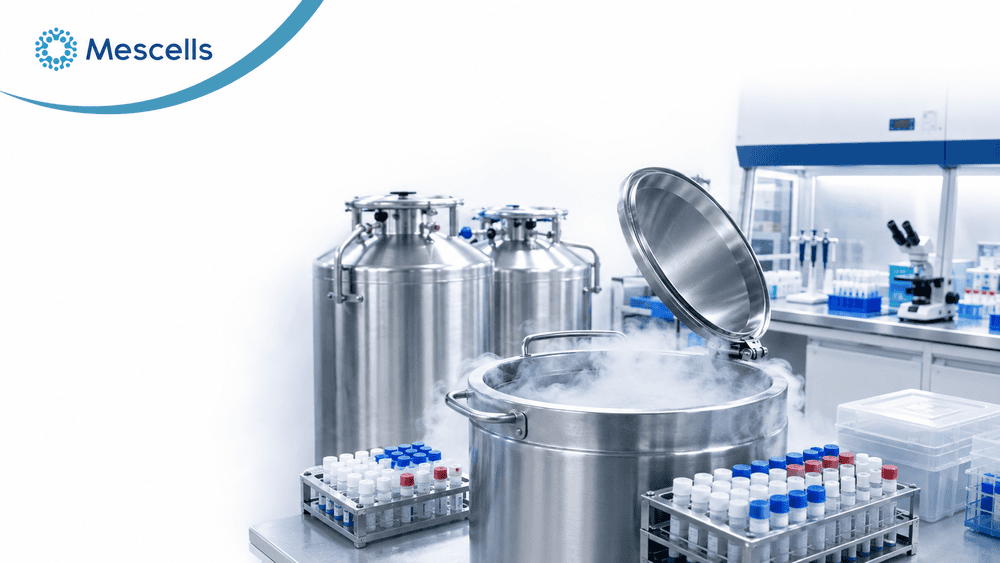
A dedicated liquid nitrogen tank system, where biological hopes are kept indefinitely under absolute deep-cold conditions
6. Current limitations and future trends
Although the technology has come a long way, we still face challenges in the cost of deep-cold infrastructure and extremely demanding requirements for highly qualified personnel. To ensure that stored samples remain stable over 20-30 years, research facilities must run periodic quality control (stability) programs in line with the strictest AABB-ISCT standards.
The future of biomedicine is shifting strongly towards full automation supported by artificial intelligence (AI-driven). We are moving closer to the era of personalized medicine, in which everyone has their own “cell bank”. This will be the key to producing targeted biological medicines that extend lifespan and raise quality of life to a new level.
Stem cell cryopreservation technology is no longer a distant concept, but a testament to the power of human knowledge in protecting life. Choosing an advanced preservation technology, from automated processing systems to vitrification and DMSO-free preservation solutions, is the most careful preparation for the future. Think of stem cell storage as a strategic investment – a priceless gift of health for ourselves and our loved ones.
MESCELLS | MSC – SPECIALIZED HEALTHCARE SYSTEM FOR REGENERATIVE MEDICINE AND CELL THERAPY
- Hotline: 0866 022 097
- Address: TT21, No. 204 Nguyen Tuan, Thanh Xuan Ward, Hanoi, Vietnam.
- Fanpage: Mescells Institute of Applied Cell Technology Research
REFERENCES:
- Rubenstein P. Cord blood banking for clinical transplantation. Bone Marrow Transplantation. 2009. https://www.nature.com/articles/bmt2009115
- Fujita Y, et al. Dimethyl sulfoxide-free cryopreservation solution for human adipose tissue-derived mesenchymal stromal cells. Cytotechnology. 2022. https://link.springer.com/article/10.1007/s10616-022-00541-3
- Reich-Slotky R, et al. Cryopreserved hematopoietic stem/progenitor cells stability program. Transfusion. 2022. https://pubmed.ncbi.nlm.nih.gov/35307845/
- Cryopreservation of human embryonic stem cells by vitrification. MedNexus/NCBI. https://mednexus.org/doi/10.1016/j.fertnstert.2005.02.046
Note: The content of this article is compiled from and refers to scientific reports and reputable medical journals around the world. However, this information is for reference only and is not a substitute for diagnosis or specialist medical treatment by a doctor.

Deputy Director, Mescells Institute of Applied Cell Technology Research


 Hotline
 Zalo
Zalo
 Fanpage