 0866 022 097
 institute@mescells.com
What Is mRNA? The Potential of mRNA Technology in Medicine


The term mRNA is no longer unfamiliar, as it was the platform behind two important vaccines of the COVID-19 era – Pfizer and Moderna. Scientists continue to study this molecule and apply it in many areas of medicine, opening up new opportunities for treating diseases such as cancer, heart disease and other infectious diseases. So what exactly is mRNA, how is the molecule organized, what does it do, and how is it applied in practice? Join Mescells to find out in the article below.
1. What is mRNA?
mRNA (messenger RNA) is a type of single-stranded RNA involved in protein synthesis. mRNA is made from a DNA template during transcription. Its role is to carry protein information from the DNA in the cell nucleus to the cytoplasm, where the protein-making machinery reads the mRNA sequence and translates each three-base codon into the corresponding amino acid in the growing protein chain [1].
2. Characteristics and structure of mRNA
To better understand what mRNA is, we need to look more closely at its characteristics and structure:
2.1. Key characteristics of mRNA
Unlike DNA, mRNA usually exists as a single strand and only for a short time. The number of ribonucleotides that make up an mRNA molecule (in other words, its length) can vary depending on the region of DNA that is transcribed. Each sequence of three nucleotides in the mRNA molecule codes for a specific amino acid, and a chain of amino acids (a protein) is then formed by decoding these base sequences in the mRNA molecule. These codes take the form of triplets of nitrogenous bases and are commonly called codons.
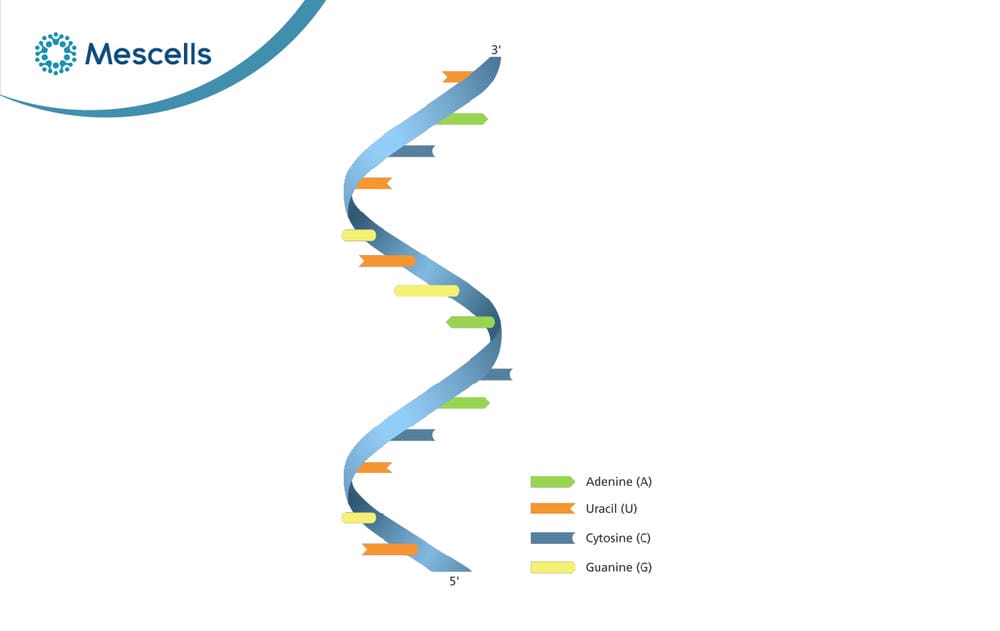
mRNA is a single-stranded RNA molecule
2.2. Structure of mRNA
A mature mRNA molecule in eukaryotes is not simply a random chain of nucleotides; it is organized into five consecutive functional regions as follows:
- 5′ cap: A modified guanine molecule (7-methylguanosine) added to the start (the 5′ end) to protect the mRNA and help the ribosome bind.
- 5′-UTR (5′ untranslated region): A non-protein-coding sequence located right after the 5′ cap and just before the coding sequence, which helps control translation.
- Open reading frame (ORF): The central and most important part, containing base triplets called codons that code for specific amino acids.
- 3′-UTR (3′ untranslated region): A non-protein-coding segment located after the stop codon, acting as a regulatory hub that helps control the stability and lifespan of the mRNA after translation has ended.
- Poly-A tail: A long chain of adenine bases attached to the 3′ end after transcription. This tail works with the 5′ cap to bend the mRNA into a closed loop, protecting the 3′ end from degradation, supporting export of the mRNA to the cytoplasm and maintaining stable translation efficiency throughout the molecule’s life cycle [2].
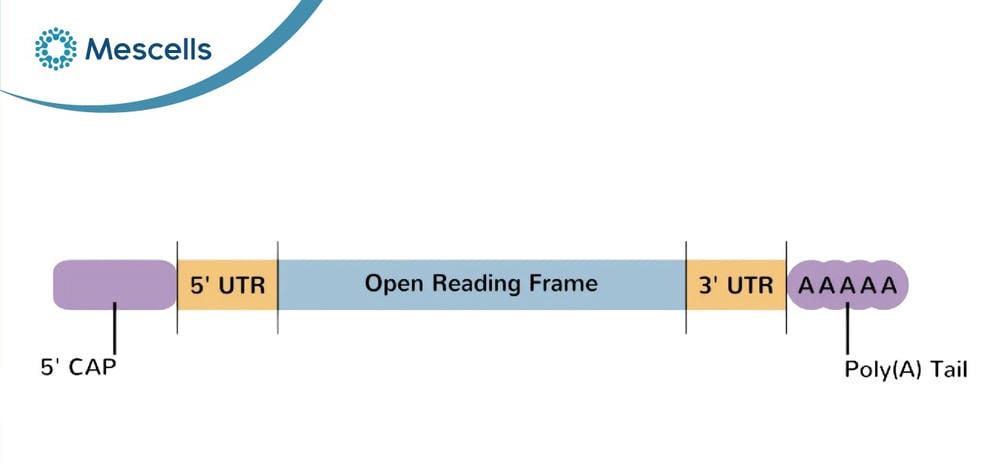
Structure of the mRNA molecule
3. Functions of mRNA
The core and most direct function of mRNA is to serve as the intermediate template for translation: the sequence of nucleotide triplets on the mRNA determines exactly the sequence of amino acids assembled on the ribosome, and therefore the structure and function of the resulting protein. In other words, every protein in the body, from enzymes and antibodies to cell receptors, is specified by an intermediate mRNA molecule before it is synthesized.
Besides serving as a template, the structure and sequence of the non-coding regions of mRNA allow the cell to apply an additional, sophisticated layer of regulation. As a result, the same protein can be produced quickly or slowly, in large or small amounts, and at precisely the right location in the cell, depending on the stability and localization signals carried on the mRNA molecule itself. A typical example is local translation at the terminals of nerve axons, where mRNA is transported and translated on site only when needed.
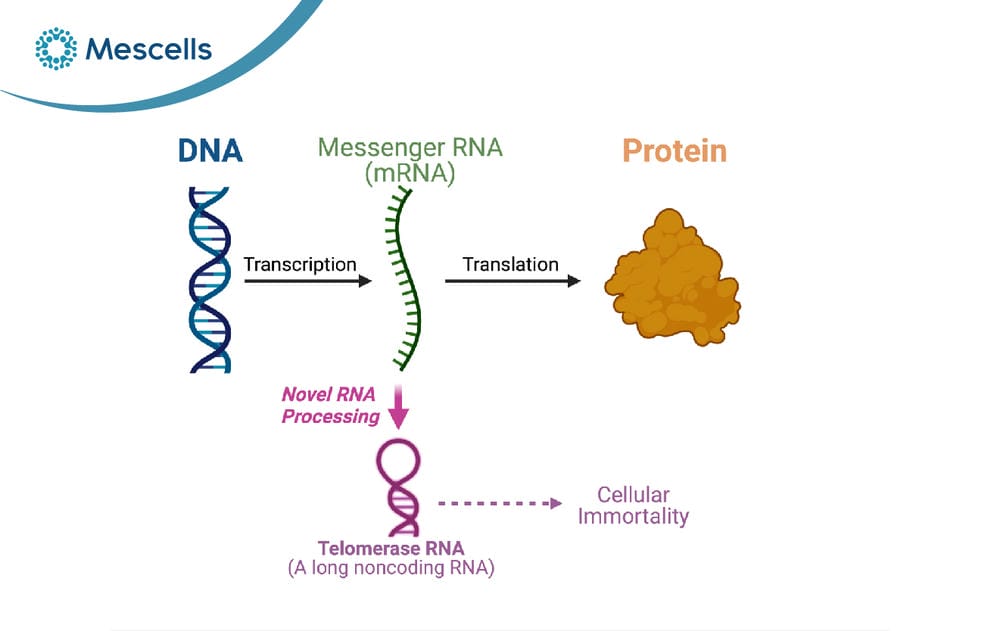
The core function of mRNA is to serve as the intermediate template for translation
4. Applications of mRNA in medicine
Because it can be rapidly designed to encode any protein, mRNA has gone beyond its role as a basic biological molecule to become a promising platform for developing new therapies and medical technologies.
4.1. Potential applications in medicine
The most important turning point that made mRNA a viable pharmaceutical was the discovery by Katalin Karikó and Drew Weissman, work that earned the two scientists the 2023 Nobel Prize in Physiology or Medicine. They showed that replacing ordinary uridine with pseudouridine in synthetic mRNA allows the mRNA to “slip past” the innate immune system – which tends to recognize foreign RNA as a sign of viral infection and trigger a strong inflammatory response – while also increasing the translation efficiency of the mRNA itself [3].
In recent years, the development of mRNA vaccine technology for preventing and controlling infectious diseases has achieved remarkable results. Compared with traditional vaccine platforms, mRNA vaccines offer several advantages, including rapid design, no need for cell culture, high immunogenicity, a relatively good safety profile in clinical studies and post-vaccination surveillance, and adaptability to many different pathogens. They are being studied and applied against viral infectious diseases, including COVID-19, influenza, respiratory syncytial virus (RSV), human immunodeficiency virus (HIV) and other pathogens [4].
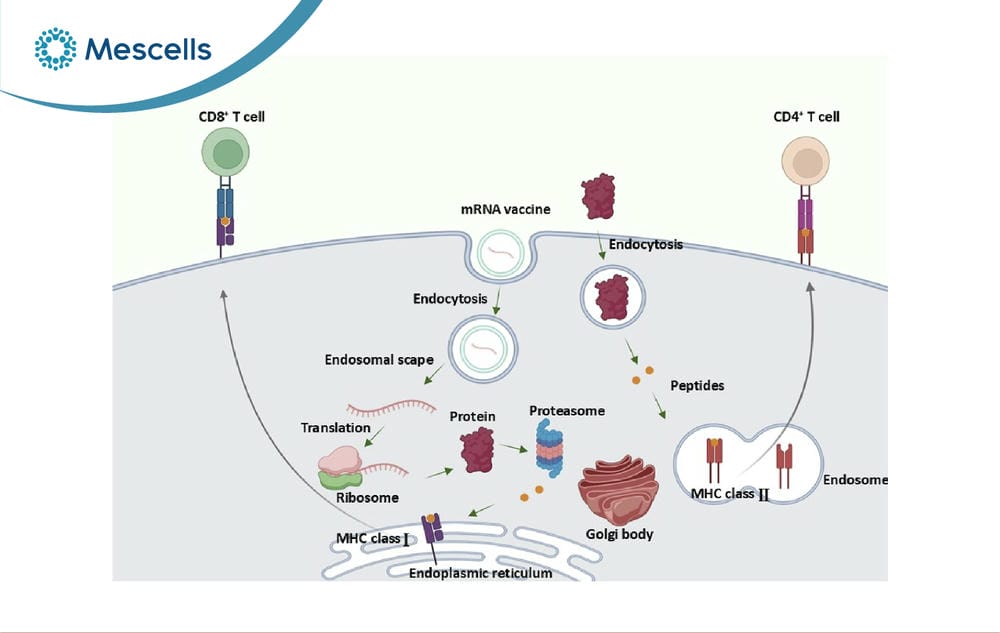
mRNA is used to produce vaccines for the prevention and control of infectious diseases
The fastest-growing application today is personalized mRNA cancer vaccines. By sequencing each patient’s tumor to identify neoantigens found only on cancer cells, scientists can design an mRNA molecule that specifically encodes dozens of those neoantigens, thereby activating the immune system to recognize and destroy that patient’s own tumor. Recently published phase 2b clinical trial results in patients with advanced melanoma showed that combining a personalized mRNA vaccine with the immunotherapy pembrolizumab reduced the risk of recurrence or death by 49% compared with immunotherapy alone [5], opening up a fully personalized approach to cancer treatment for each patient.
4.2. Remaining challenges
Although the immune barrier has been overcome thanks to modified nucleosides, the in vitro transcription process used to manufacture mRNA can still inadvertently generate double-stranded RNA (dsRNA) as an unwanted by-product. It is this dsRNA that strongly triggers non-specific inflammatory responses, requiring additional rigorous purification steps in the manufacturing process to ensure the safety of the final product [3].

The high cost of producing personalized mRNA vaccines is a significant barrier to widespread deployment
For personalized cancer vaccines, the greatest challenge lies in production cost. Each vaccine dose must be designed and manufactured individually for each patient based on tumor sequencing results, so production costs and the waiting time from sampling to the finished vaccine remain major barriers to widespread deployment, especially in countries with limited healthcare resources.
Clearly, to answer the question what is mRNA in full, we need a better understanding of the characteristics, structure and functions of this biological molecule. These are what make mRNA a foundation of modern medicine, for example in developing vaccines against infectious diseases and designing cancer therapies tailored to each patient. Understanding the structure and life cycle of mRNA not only explains why this technology has advanced so quickly in recent years, but also offers a view of the next steps medicine may achieve thanks to this special messenger molecule of the cell.
MESCELLS | MSC – SPECIALIZED HEALTHCARE SYSTEM FOR REGENERATIVE MEDICINE AND CELL THERAPY
- Hotline: 0866 022 097
- Address: TT21, No. 204 Nguyen Tuan, Thanh Xuan Ward, Hanoi, Vietnam.
- Fanpage: Mescells Institute of Applied Cell Technology Research
REFERENCES:
- (1). “Messenger RNA (mRNA)”, NHGRI, https://www.genome.gov/genetics-glossary/Messenger-RNA-mRNA
- (2). Breton Hornblower,, “Minding your caps and Poly A tails – Strategies for synthesizing in vitro transcribed (IVT) mRNA”, New England Biolabs, https://www.neb.com/en/tools-and-resources/feature-articles/mind-your-caps-and-poly-a-tails-strategies-for-synthesizing-in-vitro-transcribed-ivt-mrna
- (3). Jan Medenbach, 2023, “Nobel Prize for physiology or medicine in 2023: how to dupe the cellular innate immune system using modified RNA for therapeutic treatment”, NCBI, https://pmc.ncbi.nlm.nih.gov/articles/PMC10758357/
- (4). Jianmei Li, 2025, “mRNA Vaccines: Current Applications and Future Directions”, PMC, https://pmc.ncbi.nlm.nih.gov/articles/PMC12572956/#mco270434-sec-0030
- (5). Liz Highleyman, 2026, “Personalized mRNA Vaccine Reduces Melanoma Relapse at 5 Years”, Cancer Health, https://www.cancerhealth.com/article/personalized-mrna-vaccine-reduces-melanoma-relapse-5-years
Note: The content of this article is compiled from and refers to scientific reports and reputable medical journals around the world. However, this information is for reference only and is not a substitute for diagnosis or specialist medical treatment by a doctor.

Deputy Director, Mescells Institute of Applied Cell Technology Research





 Hotline
 Zalo
Zalo
 Fanpage